





- Humans must remain in the loop as AI advances to avoid errors and enhance jobs
- AI will create new job opportunities, including higher-end roles, not just replace labor
- AI can significantly boost India's governance and development over the next two decades
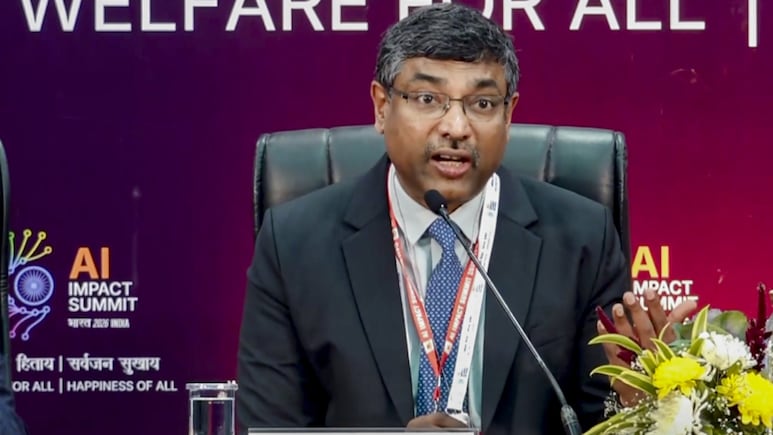
India's IT Secretary S Krishnan on Tuesday stressed that humans must always remain in the loop even as AI makes rapid advancements. He also said he does not believe mass AI adoption will be "entirely labour-replacing." In fact, he believes AI has the potential to create newer opportunities and different kinds of jobs, "including jobs at the higher end."
Speaking at an event in New Delhi, the IT secretary said we must "ensure that there is always a human in the loop. To make sure that we don't accidentally get something wrong. And we do it in a way where using AI actually enhances the capacity of the person doing the job."
The Tamil Nadu cadre IAS officer believes that AI could have a significant impact in catalysing India's ambitions of becoming a developed nation within the next two decades. He said that the Indian government has improved governance significantly, however, much more still needs to be done.
"This is a constant and evolving challenge. And one of the ways that governments are always resource constrained in terms of the number of people you can sit on some task, in terms of the funding that you have, in terms of how you can actually deliver better and clearly AI gives us that opportunity of really providing various governance services significantly better," he said.
India's 'Strategic Autonomy'
Krishnan also weighed in on the debate around "sovereign AI". He said he is not "very fond" of the term and instead prefers "strategic autonomy".
"We need to make sure that we don't become dependent on just one source or any one particular place from which something comes," he said, adding that India should have enough domestic capability across the AI value chain to ensure it remains an important part of the global ecosystem.
He argued that the goal is not to build everything in isolation, but to avoid overdependence on any one country or company. "You are interdependent. You will use inputs from a variety of sources, but you shouldn't become over-dependent or entirely dependent on any one source," he said.
According to Krishnan, building trusted supply chains with greater diversification and resilience will allow India to reduce strategic dependence while remaining integrated with the global AI ecosystem.
Looking ahead, he said AI represents a once-in-a-generation opportunity for India. If the country develops meaningful AI applications and solutions for both domestic and global markets, it could position itself as a leading AI builder.
"I, for one, certainly don't believe this is necessarily going to be entirely labour-replacing. I think it has the opportunity to create newer opportunities and different kinds of jobs, including jobs at the higher end," he said.
"If we play this right, you have an opportunity to establish India as a country that builds AI-based applications and solutions for the rest of the world," he said, adding that higher productivity driven by AI could help India move closer to its goal of becoming a developed nation over the next two decades.
On whether India needs an AI law, Krishnan said regulation will eventually become necessary. "Some kind of regulation will have to come in at some point in time... probably the time is now to start thinking about it," he said.
Track Latest News Live on NDTV.com and get news updates from India and around the world

