






Several offshore banks in places such as Zurich, Singapore, London and parts of West Asia are becoming reluctant to issue or renew international credit cards for wealthy Indians. The issue is not necessarily the customer's creditworthiness. It is India's foreign exchange rules, according to media reports.
The issue goes back to India's Liberalised Remittance Scheme, or LRS. Under LRS, resident Indians can remit up to $250,000 a year for permitted purposes. But there is an important condition attached to money sent overseas.
Unused funds cannot simply sit indefinitely in a foreign bank account. Under the 180-day deployment requirement, money remitted under LRS has to be spent or invested within the stipulated period, or the unused amount has to be brought back to India. Simply keeping the money in a foreign savings or checking account, or as a fixed deposit, does not count as deployment.
Cards linked to overseas accounts are being affected, particularly when existing cards expire and come up for renewal. Some foreign banks are reportedly reluctant to continue offering these cards because Indian residents have limited flexibility to maintain large idle balances overseas.
How To Save While Travelling Abroad
Say you are buying a Rs 1 lakh equivalent of goods abroad. The price on the shop counter may look straightforward. But the final amount appearing on your Indian bank statement can be different.
Why? Because an international card transaction can involve several layers of cost. There can be a forex markup. There can be cross-currency conversion charges. There may be an ATM withdrawal fee if you take out cash.
And then there is one particularly sneaky charge travellers need to understand: Dynamic Currency Conversion, or DCC.
When given a choice abroad, check the cost before choosing INR. In many cases, paying in the local currency is the better option. The exact cost depends on your card and its fee structure, so don't assume that every card works the same way.
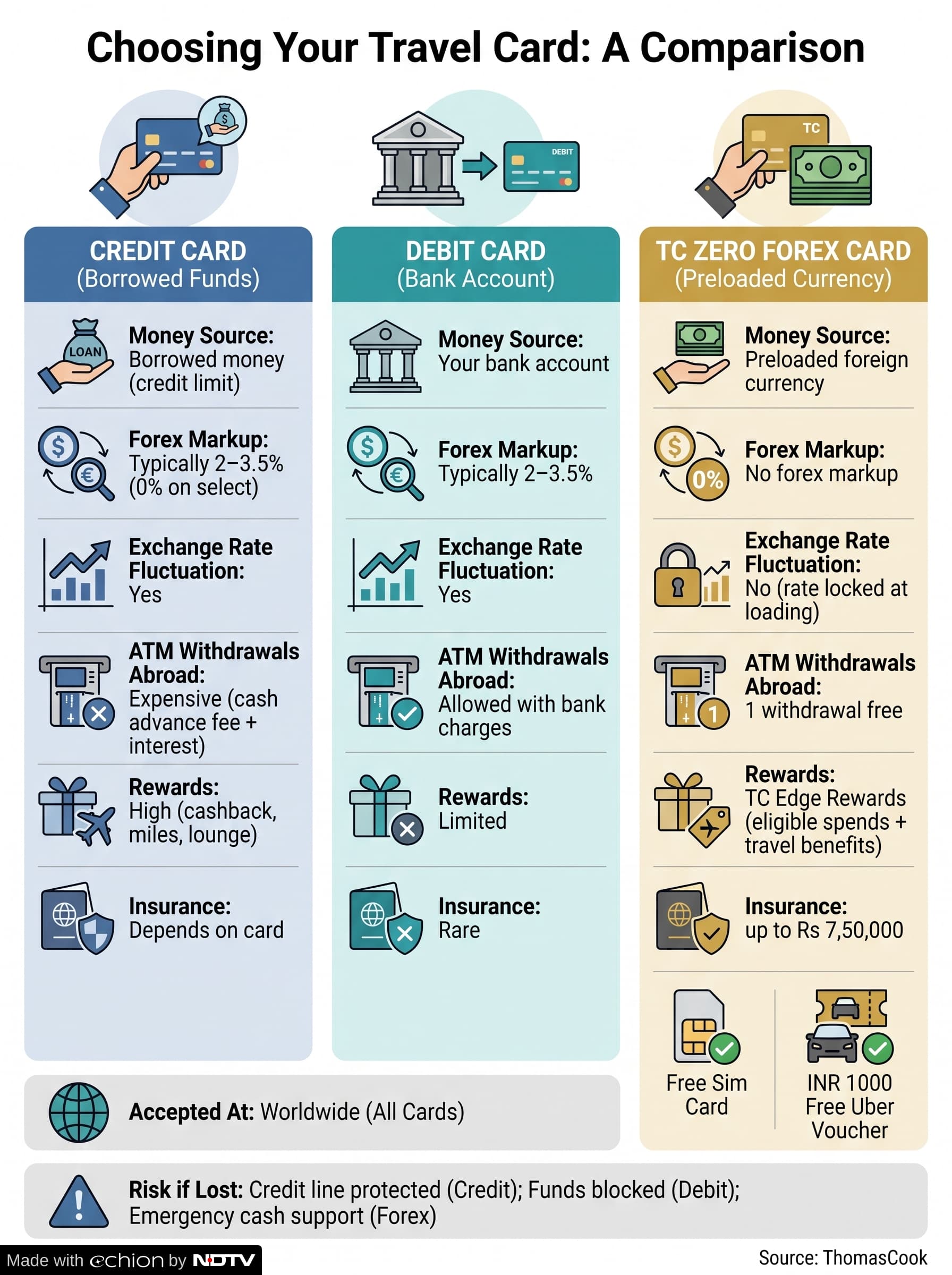
The right option depends on how much you are spending, where you are travelling and what your card charges.
1. Prepaid Forex Card: Good For Planned Trips
For a traveller who knows roughly how much money they will need, a prepaid forex card can make budgeting easier. You load money before leaving India. Depending on the product, you may be able to lock in an exchange rate at the time of loading.
That gives you greater certainty about your travel budget. It can also reduce the temptation to carry a large amount of physical foreign currency.
Deepesh Varma, Chief Business Officer - Foreign Exchange at Thomas Cook (India) Limited, said prepaid forex cards remain one of the most cost-effective options for planned international travel because they allow travellers to lock in exchange rates before departure. But he stressed that travellers should look beyond the headline exchange rate.
"The real savings often come from understanding the total cost of how one spends on ground, while abroad." That means checking the entire fee structure before buying a card.
2. A Zero-Forex Card: Useful For Frequent Travellers
If you travel abroad regularly, a credit or debit card with a low or zero forex markup can be useful.
But don't stop at the words "zero forex." Read the fine print. Check whether there are cross-currency charges, ATM fees, DCC-related charges, annual fees or other costs.
A card can be cheap in one area and expensive in another.
3. Mobile payments
Tap-and-pay and mobile wallets have made overseas payments much easier. But the payment method does not automatically eliminate forex costs.
If the underlying card carries a forex markup, that charge may still apply. So the question is not merely "Can I pay using my phone?" It is: "What card is sitting behind my phone payment, and what does it charge?"
Varma said travellers are increasingly looking for cardless payments and the convenience of managing cards and limits through mobile apps.
'Plan Forex Requirements In Advance'
Speaking on ways to save during international travel, Pavan Kavad, Managing Director, Prithvi Exchange, said, "Those intending to save money while traveling overseas should ideally anticipate and plan their forex requirements in advance instead of relying entirely on last-minute exchanges, where rates and convenience fees can add significantly to the overall cost. Travelers should also compare the exchange rates, mark-ups, and transaction charges, instead of focusing only on the headline rate."
Kavad added, "Most importantly, travelers should carry a mix of cash for immediate and smaller expenses, and forex cards for other day-to-day transactions. Travelers should also avoid frequent low-value conversions, because repeated fees and unfavorable rates can surge the cost of a trip. Ultimately, every rupee saved on last-minute currency conversion is a rupee that can be spent on the travel experience itself."
Track Latest News Live on NDTV.com and get news updates from India and around the world

