





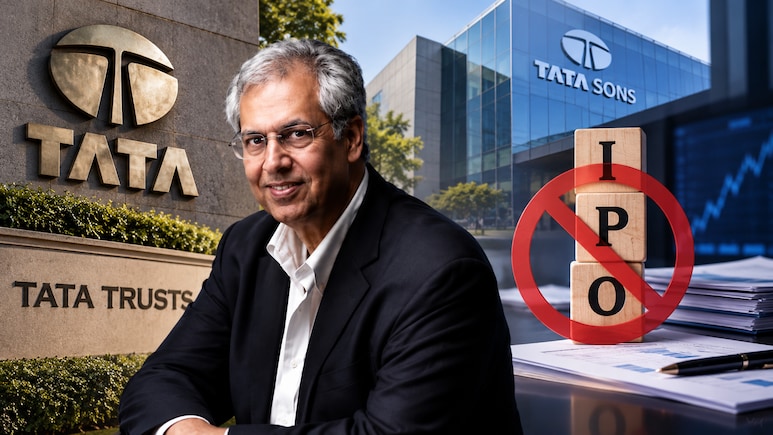
For most investors, the Tata Group means names such as Tata Consultancy Services, Tata Motors, Titan, Tata Steel, and Tata Consumer, among others.
But behind all these companies sits an important entity: Tata Sons.
It is the holding company of the Tata Group. And now, the question of whether Tata Sons itself should be listed on the stock market has become a major issue inside the group.
Also Read | Layoffs Are Rising In Tech, But These Skills Are Helping People Unlock Better Pay
On one side is the Shapoorji Pallonji Group, which owns about 18.37 per cent of Tata Sons and has backed a public listing. On the other is Tata Trusts, which owns about 66 per cent. Its chairman, Noel Tata, has opposed the move and wants other options to be explored first.
Tata Sons IPO: So, What Exactly Is The Fight About?
First, what is Tata Sons? Think of Tata Sons as the company sitting at the centre of the Tata Group. It holds stakes in several major Tata companies and plays a key role in deciding the group's overall direction.
Tata Sons is not listed on the stock market. Its shares are held by Tata Trusts, the Shapoorji Pallonji Group, Tata Group companies and some other shareholders.
The biggest shareholder is Tata Trusts, with around 66 per cent. The Shapoorji Pallonji Group is the second-largest shareholder, with about 18.37 per cent. Tata Group companies together own around 13 per cent.
That ownership structure is important because it explains why the listing question matters so much.
Why Is Tata Sons Facing Pressure To List?
The issue is linked to the Reserve Bank of India. Tata Sons was classified by the RBI as an Upper Layer NBFC, or NBFC-UL, under its Scale-Based Regulation framework.
The RBI's framework places additional regulatory requirements on such companies. Tata Sons had sought to surrender its registration as a Core Investment Company. But the RBI rejected that request on September 11, 2026 and directed Tata Sons towards the required regulatory compliance. That has brought the listing question back into focus.
The Tata Sons board has now decided to move ahead with steps linked to a possible public listing, while also saying the available options will be examined.
Why Does Shapoorji Pallonji Want An IPO?
The Shapoorji Pallonji Group has been pushing for a public listing of Tata Sons for years. Its argument is fairly straightforward.
A listed Tata Sons would have greater public disclosure and accountability. Investors would get more visibility into the holding company.
Shapoorji Pallonji Mistry has said the listing should not be viewed simply as a financial or regulatory exercise. He has argued that it could strengthen transparency and accountability while preserving the philanthropic purpose associated with the Tata legacy.
For the SP Group, there is also a shareholder issue. It owns nearly one-fifth of Tata Sons. A listing could create a public market for those shares and make it easier for shareholders to unlock the value of their holdings.
"I have repeatedly said that the public listing of Tata Sons is not merely a financial or regulatory matter. It is a social and moral imperative," said chairman Shapoorji Pallonji Mistry in a statement.
So, Why Is Noel Tata Against Tata Sons IPO?
Noel Tata's argument is very different. For Tata Trusts, Tata Sons is not just another holding company.
The Trusts' ownership is closely connected to the Tata Group's philanthropic structure. Dividends received by the Trusts help fund charitable and social initiatives.
Noel Tata has, therefore, argued that putting Tata Sons on the stock market could change the character of the institution. He has said that Tata Sons is not a conventional holding company and that its ownership structure is central to the way the Tata Group has operated for more than a century.
In his statement to the board, Noel Tata said: "A listing will destroy its character and strike at the heart of this principle." He has also argued that the company should first explore alternatives, including engaging with the RBI, seeking legal advice and examining restructuring options.
What Does An IPO Actually Change?
This is where the issue becomes important for ordinary investors. Today, Tata Sons is privately held.
If it becomes a listed company, its shares would eventually trade on the stock market. That would mean more public disclosures, financial reporting and scrutiny from investors and regulators. It could also give existing shareholders a mechanism to sell shares in the market, subject to the structure and rules of the eventual issue.
But listing would also mean Tata Sons would have to operate as a public company with public shareholders. That is the change Tata Trusts is worried about. Noel Tata has argued that the commercial pressures associated with a listed company could affect the special model through which Tata's business interests and philanthropic activities have been linked.
Is This Simply A Fight Between Two Shareholders?
Not really. The disagreement is about something much bigger. It involves three questions.
First: Regulation.
What does Tata Sons need to do after the RBI rejected its request to exit the NBFC framework?
Second: Ownership.
Should Tata Sons remain a privately held company controlled largely through Tata Trusts, or should its shares become publicly tradable?
Third: The Tata model.
Can Tata Sons become more publicly accountable without changing the ownership and philanthropic structure that has defined the group?
Tata Sons IPO: What Happens Next?
The Tata Sons board has moved towards the listing route, but that does not mean an IPO will suddenly open for investors.
"The Tata Sons listing debate is likely to move into a more structured phase, with regulatory requirements, shareholder positions and the eventual valuation of the company shaping the next steps. The immediate focus will be on how Tata Sons responds to the RBI's direction and how the board navigates the differing views of its key shareholders. If the listing process progresses, questions around valuation, stake dilution, governance, shareholder rights and the timeline for an IPO will become increasingly important," Abhishek Bhilwaria, Partner at BhilwariaFinserv, told NDTV.
For the Shapoorji Pallonji Group, a public listing could also provide a clearer route to monetise part of its Tata Sons holding, while Tata Trusts is likely to continue evaluating the implications for the group's long-term ownership and operating structure.
Track Latest News Live on NDTV.com and get news updates from India and around the world

