





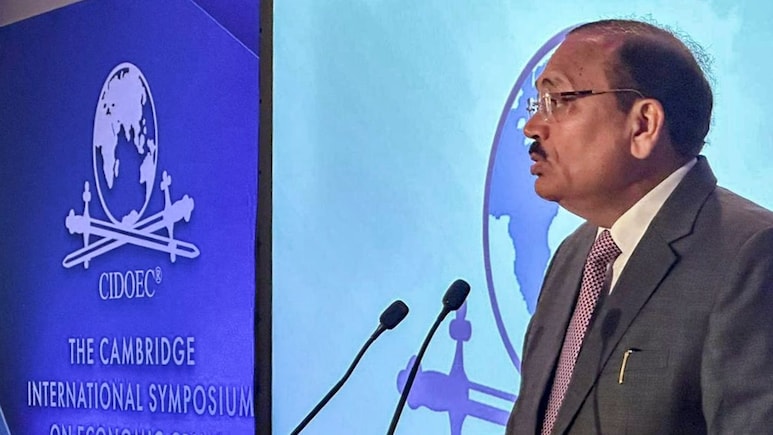
Money laundered globally in just a year is more than enough to buy every single person on Earth a modest laptop, Chief Justice of India Surya Kant said at an event in London.
Chief Justice Kant, who spoke at the 43rd International Symposium on Economic Crime at the University of Cambridge, also pointed out that the Indian judiciary has proactively responded to emerging fraudulent schemes such as digital arrest scams rather than waiting for parliament to address them.
"As of today, if the global estimates on money laundering are even roughly right, the world launders enough money in a single year to buy every one of the eight billion people alive on the planet today a modest laptop, and still have some change left," he said.
"And of that immense tide of illicit wealth, by the most generous reckoning, less than one unit in a hundred is ever recovered. If I may present this more simply, for every hundred parts of that wealth, 99 are simply referred to in speeches and reports while only one part is ever actually put right," the Chief Justice said.
"Now, I have not travelled to Cambridge to unsettle such a distinguished gathering with these statistics but instead to impress upon this congregation that this is precisely why we have all convened here this week," he added.
In the context of India, he said that the country's response to economic crime is best understood not as a single statute but as a layered architecture built over successive decades in which legislation, institutions and judicial doctrine are each made to do distinct work.
Chief Justice Kant referred to the Prevention of Money Laundering Act (PMLA), 2002, and the Fugitive Economic Offenders Act, 2018.
"I must note that these are not infallible mechanisms. Numerous individuals have alleged misuse of the PMLA process by investigating authorities, including claims of arrests made without articulated reasons, and of custody extended beyond what the existing facts appear to justify. In each such instance, the judiciary has intervened to rectify the situation," he said.
He referred to the Supreme Court's verdict holding that grounds for arrest must be provided to the accused in writing, rather than merely read aloud, adding that what had remained consistent through the decades was the Supreme Court's insistence that due process and the presumption of innocence remain the guiding principles of its jurisprudence.
The very nature of illicit wealth and economic crime was that neither honoured the sovereignty that otherwise shields legal structures from foreign interference, Chief Justice Kant said. "Let this symposium's answer be that vigilance, cooperation and the rule of law thwart fraudulence in equal and, I hope, escalating measures."
Track Latest News Live on NDTV.com and get news updates from India and around the world

