





- Union Minister Ashwini Vaishnaw signalled Apple could expand to making MacBooks and iPads in India
- Rs 62,500-crore Mobile Phone Manufacturing Scheme aims to boost India's electronics ecosystem beyond assembly
- Three potential Indian smartphone brands identified to develop strong designs and compete globally
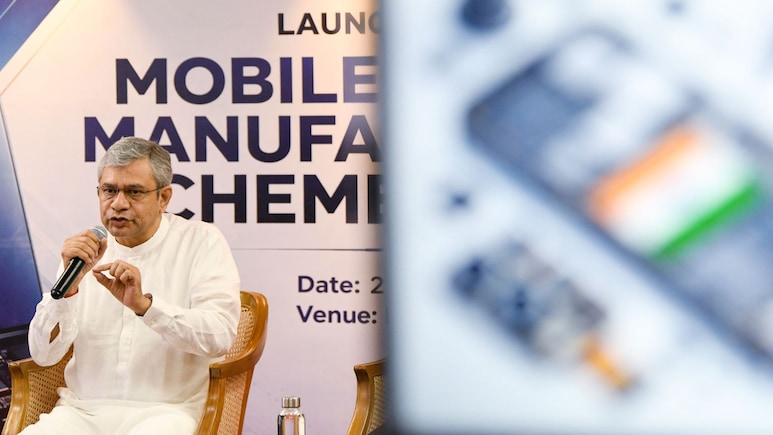
Launching the Mobile Phone Manufacturing Scheme (MPMS), Union Electronics and IT Minister Ashwini Vaishnaw said Apple could move beyond manufacturing only iPhones in India, signalling the possibility of the company expanding its manufacturing footprint to products such as MacBooks and iPads.
Vaishnaw was responding to a question seeking clarity on whether Apple could start manufacturing MacBooks and iPads in India, to which he responded, "yes." His comments come as the government seeks to use the new Rs 62,500-crore scheme to move India's electronics manufacturing ecosystem beyond scale and assembly, towards deeper localisation, design and research capabilities.
The five-year MPMS, covering FY2026-27 to FY2030-31, has two target segments: incentives for mobile-phone manufacturing and support for Indian mobile-phone brands. The scheme aims to increase global competitiveness, deepen the domestic supply chain, raise domestic value addition and build Indian brands.
Vaishnaw also stressed the importance of building design capabilities in India, particularly as the government seeks to promote Indian-owned mobile-phone companies capable of competing globally.
He said the government has identified three potential Indian smartphone players that could emerge over the next 10-14 months, and that these companies had been asked to develop the best designs for the segments in which they intend to compete.
"At this point of time, three potential players could emerge," Vaishnaw said, adding that the government sees potential for Indian brands to emerge in the coming months.
The government, Vaishnaw said, is looking beyond simply getting Indian companies to manufacture phones. The focus is on ensuring that domestic manufacturers develop their own intellectual property, product design and technology capabilities.
According to the scheme notification, an Indian brand must be incorporated in India, hold its intellectual property and trademark in India, have management control with Indian citizens, have more than 51 per cent Indian citizen shareholding, and maintain in-house R&D and design capabilities in India.
Vaishnaw said the government would examine the IP and quality of designs being developed by potential Indian players before extending support.
MeitY Secretary S Krishnan said the scheme has specifically earmarked an incentive for building research capabilities among Indian manufacturers.
"Under the scheme, the government has come up with a plan to build a domestic mobile phone brand and it is also providing a 3 per cent incentive on research and development programs of companies," Krishnan said earlier.
Officials familiar with the matter said companies will have to meet a benchmark of research and development capabilities to qualify for the incentive. The scheme notification provides an additional 3 per cent incentive on eligible sales for Indian design and R&D, over and above the 5 per cent base incentive for Indian brands and the additional incentive of up to 1.5 per cent for domestic sourcing.
That makes the R&D provision one of the clearest departures from a manufacturing-only approach. For Indian brands, the base incentive is 5 per cent, with another up to 1.5 per cent available for domestic sourcing of key components and 3 per cent for Indian design and R&D.
The government is simultaneously using the scheme to push localisation of the wider mobile-phone supply chain. Manufacturers can receive up to 1.5 per cent additional incentive for domestic sourcing of display modules, camera modules, enclosures, batteries and USB cables, provided the relevant components are localised for at least 25 per cent of mobile-phone units sold in a financial year.
The push comes after a decade of rapid growth in India's electronics industry. Government data presented at the launch showed that electronics production has risen sevenfold since FY2014-15, and electronics exports 11-fold. Mobile-phone production has increased 33-fold, while mobile-phone exports have risen 166-fold. India is now the world's second-largest mobile-phone manufacturer by volume, with 99.2 per cent of mobile phones used in India made domestically.
The earlier PLI programme has also substantially exceeded several of its targets. Investment under PLI 1.0 reached Rs 20,587 crore, against a Rs 7,000-crore target, while cumulative production reached Rs 11.62 lakh crore, or 142 per cent of the target. Exports stood at Rs 6.43 lakh crore, 132 per cent of the target.
With MPMS, the government is targeting cumulative mobile-phone production of around Rs 39 lakh crore during the five-year scheme period, and exports of around Rs 15 lakh crore, while generating 60,000 direct jobs in mobile manufacturing and allied sectors.
Track Latest News Live on NDTV.com and get news updates from India and around the world

