





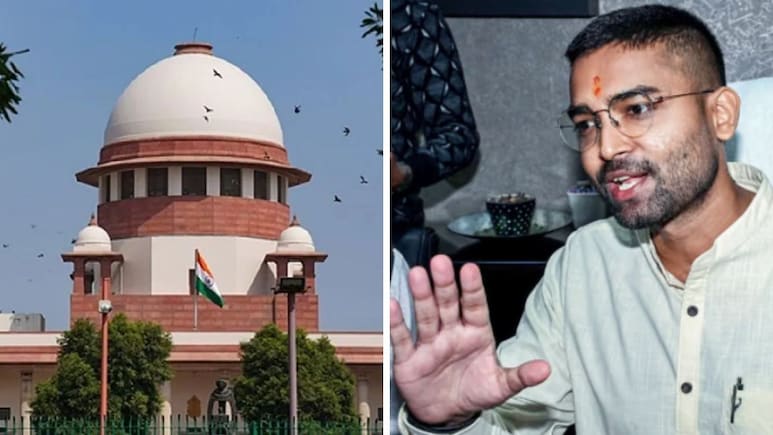
- Bihar minister Deepak Prakash served over six months without being elected to legislature
- Article 164(4) mandates ministers be elected within six months or cease to hold office
- Prakash’s two separate stints total over six months, raising legal questions on grace period
The Supreme Court has asked the Bihar government to explain how a minister is continuing in office despite not being elected after a mandatory period of six months.
The court is hearing a petition challenging the continuation of Bihar minister Deepak Prakash in office beyond six months despite not being elected.
Chief Justice of India Surya Kant on Thursday posed the question to the Bihar government.
"This is a pure question of law. The State will have to explain how a minister is continuing for over six months without being elected," the CJI said.
The court has listed the matter for urgent hearing on August 4.
Facts Of The Case
The challenge arises from the continuation of Bihar Panchayati Raj Minister Deepak Prakash without being elected.
Prakash served as Minister of Panchayati Raj for four months and 26 days before Chief Minister Nitish Kumar stepped down on April 15, 2026, bringing his tenure to an end.
He held no ministerial office for the next 22 days.
On May 7, after Samrat Choudhary formed a new government, Prakash was again sworn in as minister despite remaining unelected.
The petition, filed on May 30, seeks to have his appointment declared invalid, alleging it is "a fraud upon the Constitution".
Prakash has now held office for more than six months in aggregate without being elected to either House.
What Does The Law Say
Article 164(4) grants ministers a grace period of six months to get elected when appointed by the Prime Minister or a Chief Minister.
It states: "A Minister who for any period of six consecutive months is not a member of the Legislature of the State shall at the expiration of that period cease to be a Minister."
So, a minister must quit office if not elected within a period of six months.
Why Bihar Case Is Different
But Prakash's case is unusual as he has not held office for six months in one go.
Under Nitish Kumar, he was minister for four months and 26 days, which was within the six-month grace period.
In his current stint, after being appointed again by Chief Minister Samrat Choudhary, he has served only a couple of months. But taken together, he has remained a minister without being elected for more than six months.
This poses a curious question of law before the Supreme Court.
Article 164(4) has been invoked extensively by ministers and chief ministers appointed without holding a seat in the legislature. The standard practice is to then have an elected legislator in a "safe seat" resign so that the minister can contest a by-election.
Past Examples
Many times, ministers and chief ministers have taken the Legislative Council route to fulfill the condition of being elected within six months.
In 2019, Uddhav Thackeray became Maharashtra's chief minister without being an MLA. He was later elected to the state's Legislative Council.
In Uttarakhand, Tirath Singh Rawat, who took CM's office in 2021, resigned shortly before the six-month deadline after the COVID-19 pandemic made holding a by-election difficult.
Even former Prime Minister HD Deve Gowda was elected to the Rajya Sabha after becoming PM.
The Big Questions
The practice of getting a minister elected months after assuming office is by itself not controversial.
But can the six-month grace period be invoked twice for the same minister?
Is it permissible for a minister to resign before the six-month deadline, assume office again after a few days, and claim that the six-month clock will reset from the new swearing-in date?
The Supreme Court ruling in the Deepak Prakash case will clarify this grey area in the interpretation of the law.
Track Latest News Live on NDTV.com and get news updates from India and around the world

