





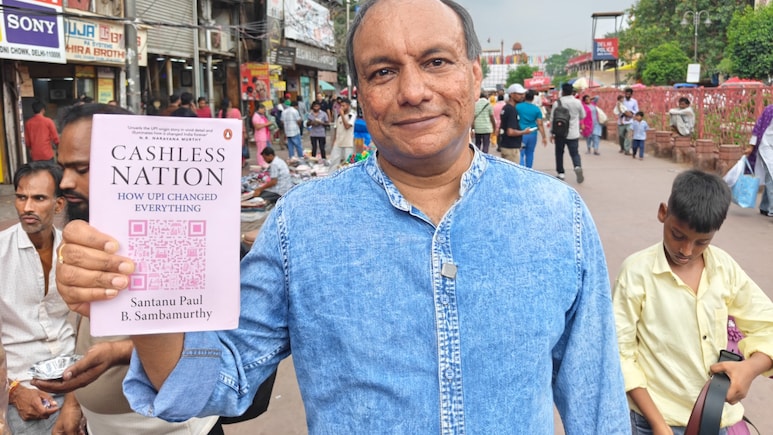
Standing amid the bustling lanes of Chandni Chowk, a nearly 400-year-old market and today one of India's largest trading hubs where an estimated Rs 50,000 crore worth of business is conducted every year, the story of modern India is unfolding one QR code at a time. Shopkeepers, wholesalers, hawkers and customers who once depended almost entirely on cash now complete transactions in seconds using a smartphone.
What has powered this transformation is the Unified Payments Interface, better known as UPI, India's homegrown digital payments network that has become one of the world's biggest financial technology success stories. It is truly the world's envy, India's pride! UPI began a decade ago on August 26, 2016.
The journey from a cash-dominated economy to a rapidly digitising nation is documented in the book 'Cashless Nation: How UPI Changed Everything', co-authored by computer scientist Dr Santanu Paul and B Sambamurthy, a career banker. Paul served as an Independent Director on the board of the National Payments Corporation of India, or NPCI, the organisation that built and operates the UPI backbone.
The 316-page first-of-a-kind story told by experts who have had a ringside view on the digital payments revolution as it unfolded has been published by Penguin Random House publishers. Nandan Nilekani, founding chairman of the Unified Identification Authority of India (UIDAI), better known as Aadhar, and chairman of Infosys and man who enabled and catalysed the UPI framework, says, 'This is the tale of a country that went from a laggard to a leader in just a few years. 'Nilekani adds, 'The Unified Payments Interface, or UPI, has emerged as an undisputed superstar... None of this was an overnight success. The evolution took decades and gathered serious momentum only in the last decade and a half... Cashless Nation is a chronicle of that remarkable journey and the many personalities, incidents and obstacles along the way. It traces the major debates, the critical trade-offs, the complex choices... It explains why India chose to build public rails for private innovation, a model that delicately balances sovereign control with market vitality.'
According to the Indian government, one in two real-time digital payments of the world takes place in India, nearly Rs 1 crore worth of transactions take place on UPI every second. In 2025-26, India made payments worth Rs 314 lakh crore through UPI. Today UPI is operational in 11 countries, including France, Singapore and the UAE. Amazing population-level infusion of technological revolution which it calls 'digital, self-reliant and worry-free'. Interestingly, one hears of digital arrests and cyber fraud in banks but almost no hacking of the UPI systems.
Speaking to NDTV in the bustling, energetic Chandni Chowk, Dr Paul described UPI as a technology that fundamentally changed how India transacts money.
Today, more than 55 crore Indians use UPI, and about 6.5 crore merchants accept payments through the platform, says Paul. What began as a digital payments experiment has become the backbone of India's daily commerce.
According to Dr Paul, transactions worth nearly ₹1 lakh crore can take place through UPI on a busy day. From vegetable vendors and tea sellers to large retail chains, millions of merchants now depend on QR code-based payments.
What makes UPI unique is that it was designed not as a private business seeking profits but as a public digital utility. The biggest advocate of Fintech adoption, Prime Minister Narendra Modi, says, 'Today, from the street vendor to the showroom of your car, all your payments are done just by scanning a QR code.'
Unlike payment systems dominated by private corporations elsewhere in the world, like Visa and Mastercard, India's UPI was built as public infrastructure. Whether a customer is wealthy or poor, whether a merchant operates a multinational company or a tiny roadside stall, everybody has access to the same network.
Dr Paul describes this as perhaps India's biggest achievement in financial inclusion.
For decades India struggled to bring millions into the formal financial system. UPI changed that equation by making digital payments simple, cheap and accessible.
The beauty of the system lies in its interoperability.
A customer may, for example, use Google Pay linked to Punjab National Bank. A merchant may use Paytm linked to the State Bank of India. Yet money travels seamlessly between multiple institutions within seconds, here a four-party system. Paul says, 'What makes UPI so revolutionary and acceptable is because it is frictionless, and very rarely do transactions fail.'
The customer does not need to know the complexity behind the transaction. The payment moves through the app, the bank, NPCI, the receiving bank and finally reaches the merchant almost instantly. That simplicity is precisely what turned UPI into a national phenomenon.
A major enabler was the humble QR code.
Originally developed in Japan for industrial inventory management, QR code technology was later adapted for payments. In India it evolved into a common standard.
Unlike earlier payment ecosystems where users and merchants often needed to belong to the same platform, India's QR code became interoperable. One QR code could accept payments from virtually every major UPI application.
The result was explosive growth.
Millions of small merchants who never had credit card machines suddenly became digitally connected. A shopkeeper could start accepting digital payments with a printed QR code costing almost nothing.
The rise of UPI was not an accident. According to Dr Paul, five major developments helped create the perfect conditions for a digital payments revolution.
The first was the rapid spread of smartphones and mobile internet.
Even before many Indians had bank accounts, they had mobile phones. Affordable smartphones gave citizens a digital identity and a direct connection to financial services.
The second was the JAM trinity architecture consisting of Jan Dhan bank accounts, Aadhaar and mobile connectivity. Together these systems provided the foundation for digital financial services, also often called the India Stack.
The third major catalyst was demonetisation in 2016.
While opinions on demonetisation remain divided, there is little doubt that it accelerated the shift toward digital payments. Millions of Indians who had never used digital transactions before began experimenting with electronic payments.
The fourth important step came through direct benefit transfers or DBT.
Government welfare payments increasingly moved directly into citizens' bank accounts. This strengthened the banking ecosystem and familiarised millions with digital financial transactions.
The fifth catalyst was the COVID-19 pandemic.
Suddenly contactless payments became desirable. People were reluctant to handle currency notes. Online commerce surged. Digital payments experienced another dramatic jump.
Together these developments created what Dr Paul calls a `tsunami of adoption'. Initially PayTM had the first-mover advantage, but poor regulatory governance of its platform made India's central bank snip its wings as it began to soar.
However, the very success of UPI has now triggered a major debate.
For years UPI transactions have operated under a zero Merchant Discount Rate, commonly called MDR.
MDR is the fee merchants typically pay to banks and payment networks for processing digital transactions. Around the world these charges are common. Credit card transactions often attract fees ranging from one to two per cent or even more.
In January 2020, India took the unusual step of eliminating MDR for UPI and RuPay transactions. The goal was straightforward. Encourage adoption at scale.
The strategy worked spectacularly.
Small merchants embraced digital payments because they could accept money without paying transaction fees. Consumers loved the convenience. The ecosystem grew rapidly.
Now the debate has returned.
The government has discussed frameworks that could potentially allow MDR on certain categories of UPI transactions in future, particularly involving larger merchants. Finance Minister Nirmala Sitharaman has stated that no transaction charge will apply to ordinary users and small merchants and that no MDR framework has yet been finalised. Recent discussions revolve around creating a sustainable funding model for banks, fintech firms and payment infrastructure providers that continue to invest in cybersecurity, innovation and network expansion.
The Finance Minister, Nirmala Sitharaman, firmly declared in the Parliament during the Monsoon session, "Will consumers pay any UPI charge? No. UPI has remained free for consumers since its launch, and every Indian will continue to make this instant digital payment without paying any transaction charge." She added: The new bill amends Section 10A of the Payment and Settlement Systems Act, 2007, it serves as an "enabling provision" that grants the central government the legal backing to decide, via official notification, which specific electronic payment modes must remain free.
Critics, however, fear that even small merchant charges could eventually affect consumers. Businesses may choose to pass on costs through higher prices, convenience charges or other mechanisms.
Dr Paul argues that UPI's extraordinary success is closely linked to its free-to-use structure.
The reason millions of small merchants adopted the platform was because it cost them nothing. Any future changes, he suggests, should be approached very carefully to preserve the gains achieved over the last decade since UPI could grow fivefold in the next decade.
The debate has also acquired an international dimension.
Several policy analysts and trade experts have noted that global card networks such as Visa and Master Card have faced increasing competition from UPI and RuPay as Indian consumers shifted toward domestic digital payment systems. Reports published this month indicate that the United States Trade Representative has raised concerns over India's zero MDR framework, arguing that it creates an uneven competitive environment for foreign payment companies. Some Indian political leaders and commentators have linked the MDR debate to broader trade discussions involving the administration of US President Donald Trump, although the Indian government maintains that any future decision will be based on domestic policy considerations and ecosystem sustainability rather than external pressure.
The larger question is whether India should alter a model that has become a global benchmark.
Today countries around the world are studying India's digital public infrastructure. UPI has expanded internationally, and Indian travellers can increasingly use the system abroad.
Back in Chandni Chowk, a simple purchase of a Rs 50 smartphone-powered fan demonstrates the elegance of the system. A scan, a PIN and within seconds the money reaches the merchant.
No paperwork. No counting notes. No waiting for change.
That small transaction captures a much larger story.
UPI has transformed India's relationship with money. It has helped millions enter the formal financial system. It has empowered small businesses, improved ease of doing business and demonstrated how public digital infrastructure can operate at a massive scale. Though Dr Paul does point out the digital payments network and its massive database does give the government to impose income tax on users. One big challenge emerges when there are internet blackouts or shutdowns, the entire UPI system runs riding on the information superhighway called the Internet. No internet means all of this cashless digital backbone comes to a grinding halt.
From the crowded markets of Old Delhi to global discussions on digital payments, India's fintech revolution has become a case study for the world. Today most charitable organisations also take UPI payments in what they call E-Hundi, even the Ram Mandir at Ayodhya takes digital donations since Paul says `faith and fintech are good friends'.
And if current trends continue, the journey towards becoming a truly cashless nation is only just beginning.
Track Latest News Live on NDTV.com and get news updates from India and around the world

