




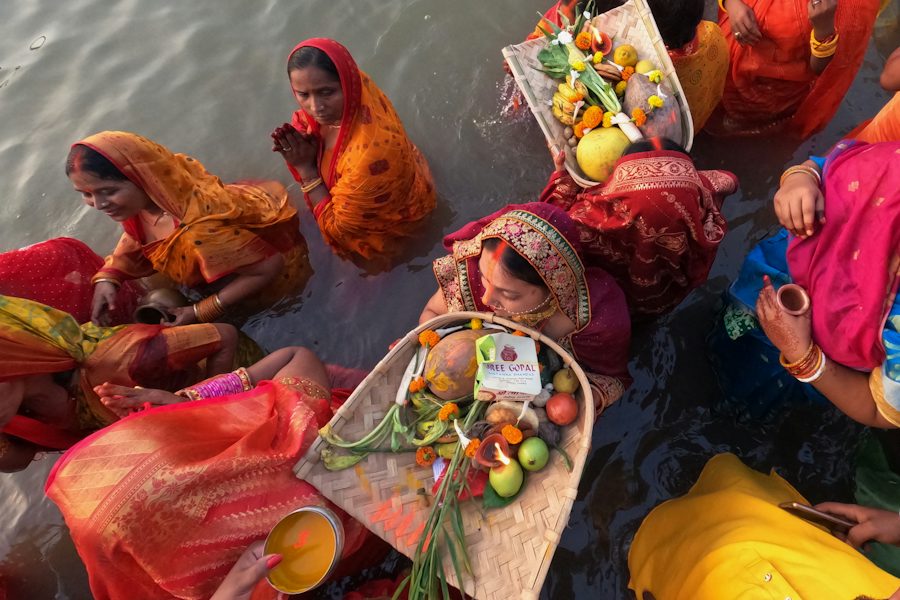
As the sun sets on November 15, thousands of devotees will wade knee-deep into the Yamuna at Delhi's ghats to offer arghya to the Sun God. Before dawn the next morning, they will return to the very same waters for the final, sacred prayers of Chhath Puja.
But the water they step into is far from identical.
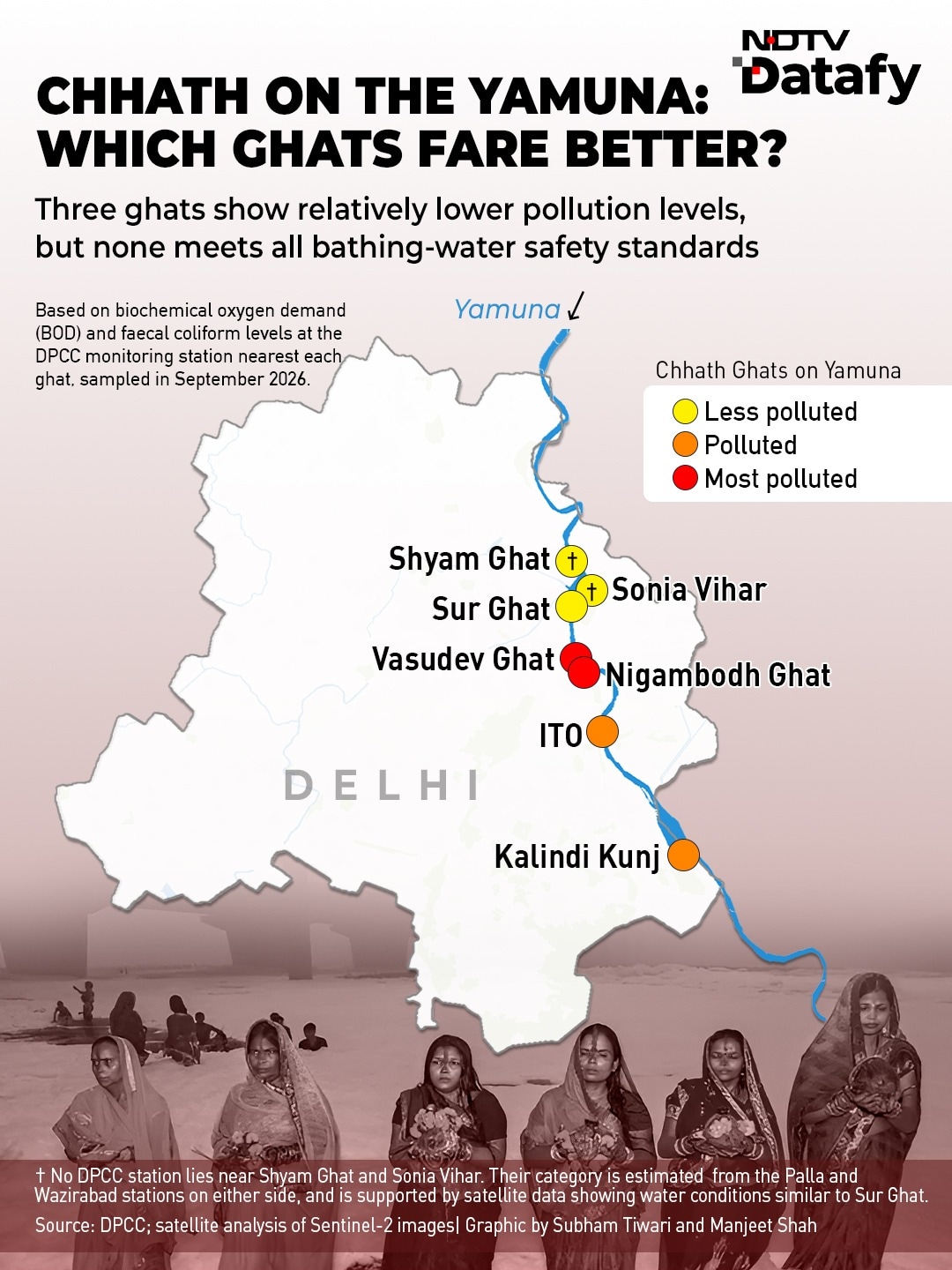
An NDTV Datafy analysis of Delhi Pollution Control Committee (DPCC) data and satellite images shows that none of the seven major Yamuna Chhath ghats meet the government's standards for bathing water.
The three ghats located upstream of Wazirabad (Shyam Ghat, Sonia Vihar, and Sur Ghat) come relatively close to meeting permissible safety limits; the four major ghats downstream are far outside the safety thresholds.
For devotees who want to offer arghya in the Yamuna, the upstream ghats are the better choice.
What The Bathing Water Standards Say
Under the Centre's bathing water standards, biochemical oxygen demand (BOD), a measure of sewage and other organic waste, should be 3 mg/L or less. Faecal coliform, bacteria from human and animal faeces, should ideally stay below 500 and must never exceed 2,500.
Faecal coliform matters most for devotees, as high counts raise the risk of stomach, skin and eye infections.
The 3 Less-Polluted Ghats
Shyam Ghat, Sonia Vihar and Sur Ghat lie between Palla, where the Yamuna enters Delhi, and Wazirabad, where a big drain joins the river. On this stretch, biological oxygen demand (BOD) stays between 2 and 4 mg/L, and faecal coliform remains within the permissible limit.
BOD measures how much organic waste is in the water. In the Yamuna, that waste is mostly sewage. High BOD levels mean a threat to fish and other river life. Faecal coliform is a group of bacteria and isn't harmful itself. But they travel with germs that cause diarrhoea, typhoid, cholera, hepatitis A, and skin and eye infections. A higher count implies a greater risk of catching something from the water.
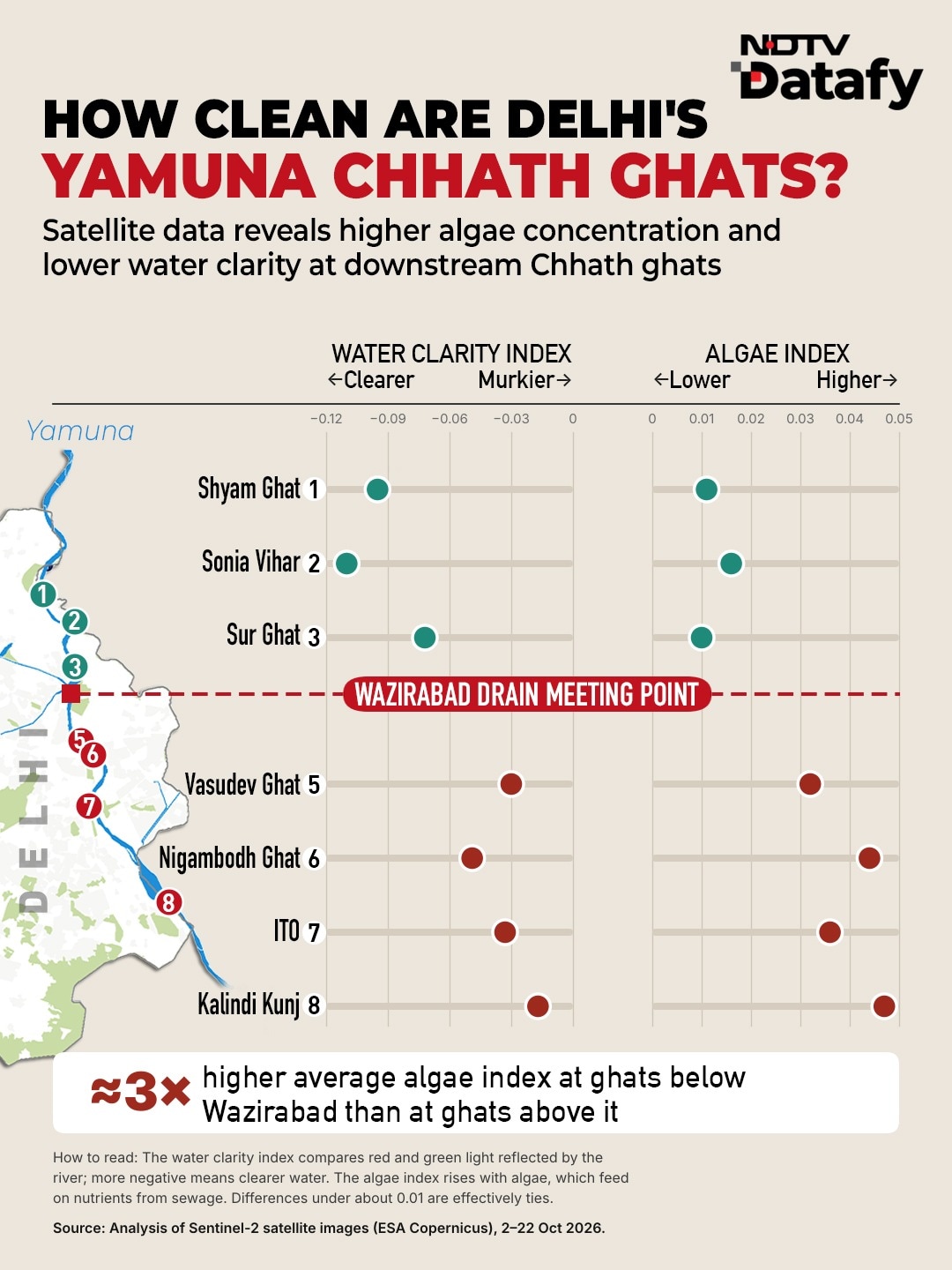
Sur Ghat lies some hundred meters downstream of the Delhi Pollution Control Committee's (DPCC) Wazirabad station. DPCC does not sample near Shyam Ghat or Sonia Vihar, but both sit between its Palla and Wazirabad stations, and the river is in the less-polluted range at both. Satellite images also show the water at these two ghats is as clear, and as low in algae, as at Sur Ghat.
Even so, these ghats fall short of the standard. At Wazirabad, BOD is a third above the limit, and faecal coliform is more than twice the desirable level.
Pollution Spikes After Wazirabad Stretch
Below Wazirabad, the river changes sharply. By ISBT Bridge, BOD has risen from 4 to 30 mg/L, and faecal coliform from 1,300 to 35,000. Vasudev Ghat and Nigambodh Ghat at Kashmere Gate, situated near DPCC's ISBT Bridge station, are the most polluted. Faecal coliform there is 14 times the maximum permissible level.
ITO Chhath Ghat, about 200 m from the ITO Bridge station, and Kalindi Kunj, about 350 m from the Okhla Barrage station, fare slightly better. But faecal coliform at both is still 7 to 8 times the limit.
Sewage also carries nutrients such as phosphate, which rises about eightfold between Wazirabad and ISBT. These nutrients feed algae.
No Ghat In Delhi Is Fit For Bathing As Chhath Arrives, But 3 Come Close (Caption: October satellite images (October 2-22) were used because November's smog distorts satellite readings and river conditions after the monsoon remain broadly similar through Chhath.) https://t.co/TnReDjdAgN
— NDTV (@ndtv) November 13, 2026
What Satellites Show
Satellite images show the same break at Wazirabad. NDTV Datafy analysed Sentinel-2 images from October to measure how clear the water is and how much algae it holds in the river next to each ghat.
The three upstream ghats have the clearest water and the weakest algae signal. Below Wazirabad, the water turns murkier, and the algae signal is about three times stronger. As algae decay, they use up the oxygen that river life depends on.
Kalindi Kunj records the highest readings on both, partly because still water and weeds behind the Okhla barrage can push them up. The Yamuna at Kalindi Kunj has white, toxic foam floating on the surface.
Track Latest News Live on NDTV.com and get news updates from India and around the world

