Satyagraha, Pyre On River: Tribals' Unique Protest To Save Their Homes
As the Ken-Betwa river-linking project advances, thousands in Madhya Pradesh's Chattarpur say they face displacement, lost livelihoods and inadequate rehabilitation, and are mounting Gandhian-style protests.
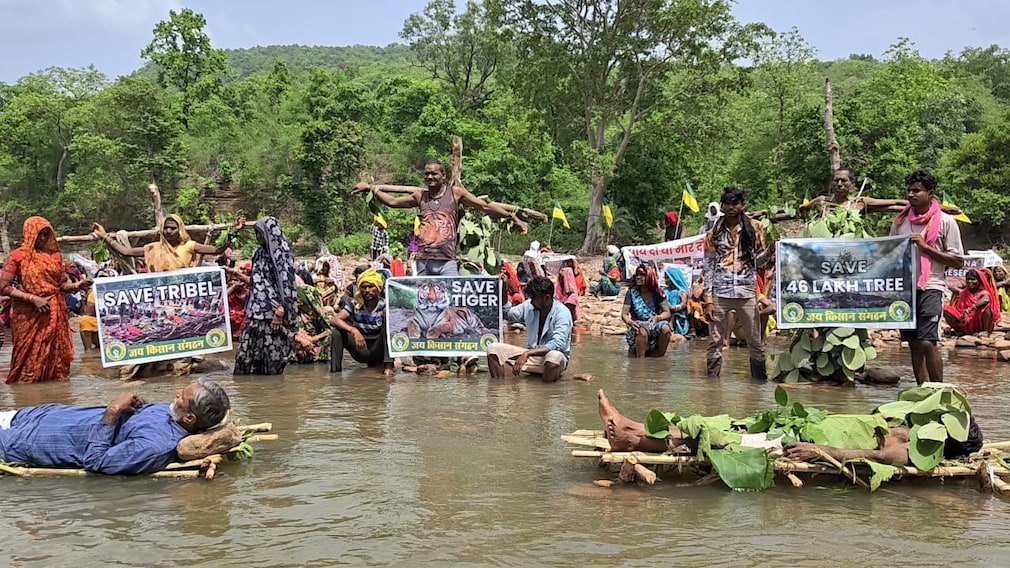
Mahatma Gandhi has returned - in spirit - to Madhya Pradesh's Chhatarpur, where tribal communities are holding protests - from the 'aamran anshan' ('fast unto death') and 'chita andolan' (funeral pyre protest) to the 'mitti' and 'jal' satyagrahas (protests of the soil and water) - to protest the fallout of the Ken-Betwa river-linking project.
The project, they have cried, has cost them homes and livelihoods, and there has been no compensation. They have also argued that promises made in April have been ignored, while they face wrongful police cases and forced evictions.
One set of protesters - gathered under the bridge across the Barana River - built funeral beds on which men lay and floated on the river, warning the state government of their deaths. Another set - also at the Barana site - hung nooses around their necks to signify a 'hanging satyagraha'. And activist-leader Amit Bhatnagar is on an indefinite hunger strike.
The local administration, meanwhile, has insisted assurances have been met. "The state enhanced relief and rehabilitation… now they want more," District Collector Parth Jaiswal said.
This confrontation is happening in Bundelkhand.
To those who know it, it is a vast expanse of land - around 70,000 sq km - in central India that lies between the Indo-Gangetic Plain and the Vindhya Mountains.
Spread across 13 districts divided between Uttar Pradesh and Madhya Pradesh, including Chhatarpur, it is a rocky and rugged land, rising from deep ravines to imposing plateaus and clothed in forests and home to major heritage hotspots, including the world-famous Khajuraho temple complex - a UNESCO World Heritage site - and the Panna National Park.
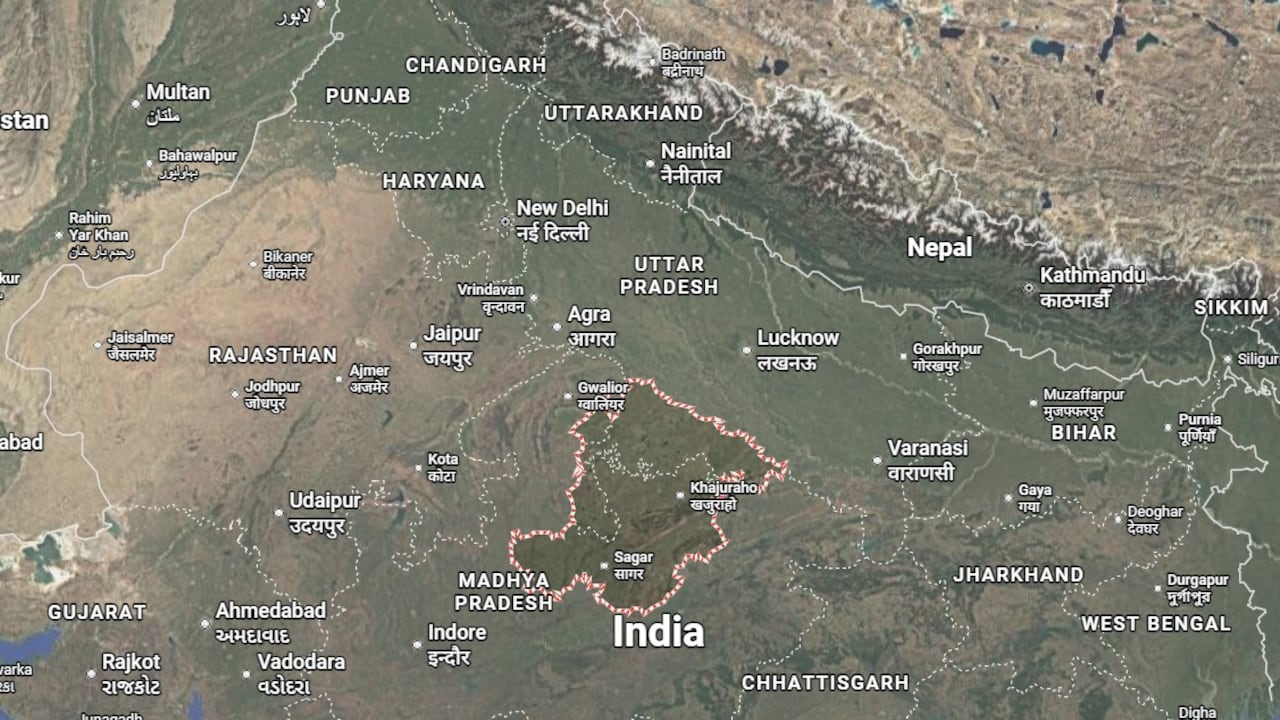
The Bundelkhand region in central India (Photo: Google Maps)
But it is also a semi-arid landscape in which blisteringly hot summers - when temperatures routinely cross 45 degrees Celsius - are paired with inconsistent and often low monsoons.
The searing heat and rocky terrain, which causes what rain does fall to flash flood out of the region rather than replenish underground aquifers, underline the harsh realities of life here, which also include deforestation, fractured agricultural output, and out-migration in search of jobs.
That is why Bundelkhand is often linked to issues like drought and starvation. In this context, the linking of the two biggest water resources - the Ken and Betwa rivers -is a significant initiative for Bundelkhand's development and irrigation needs.
Why the protests
However, as with any large-scale development project - particularly one requiring machine-intensive engineering to actively alter geography - there are concerns over how it might affect the tens of thousands of families who call the area home.
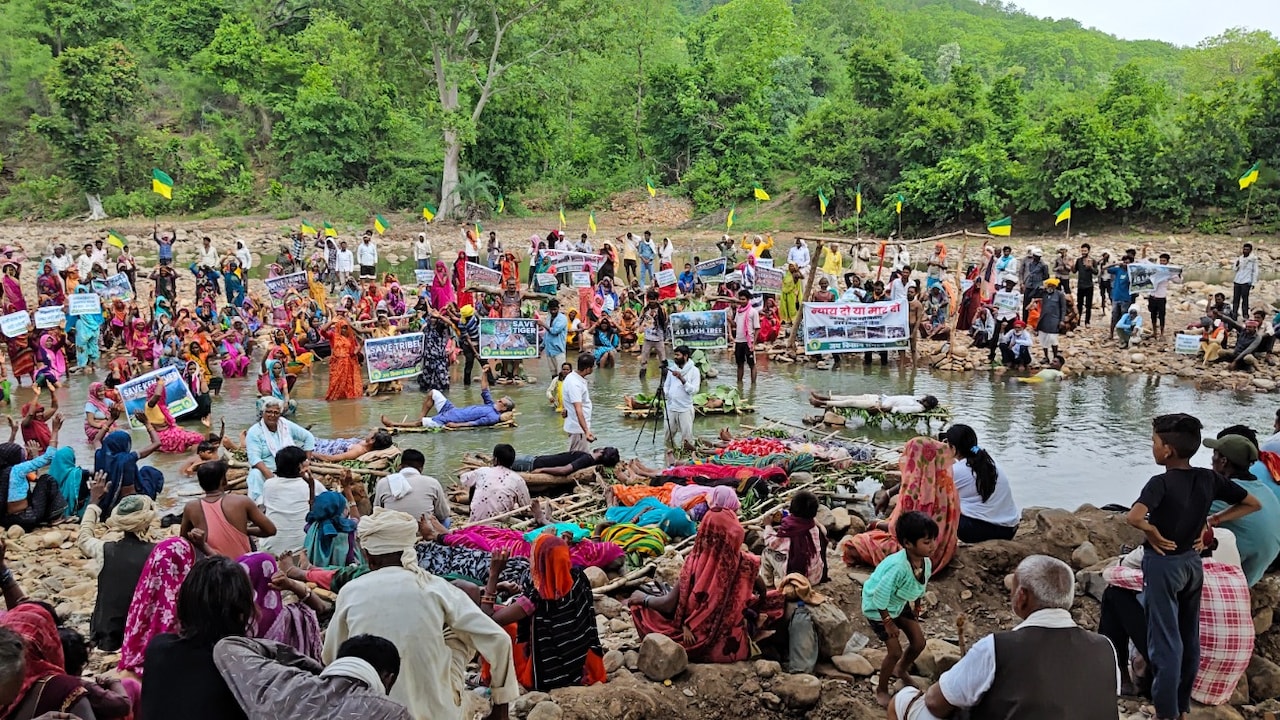
Protesters carry out a 'chita andolan', a funeral pyre protest.
And for nearly two dozen villages in Madhya Pradesh's Chhatarpur district, those concerns are now sitting on their doorsteps.
Over 50,000 people from this region will be impacted, directly or indirectly, by the Ken-Betwa project. Some will be forced from their homes, while others could see their livelihoods - frugal and fragile as they are - wiped out.
The wildlife will suffer too. The Panna forests are home to at least 80 tigers.
Environment and civil society activists working with these families have said the worry is not about the project itself, for no initiative that brings water to Bundelkhand can be ignored. But water at the cost of their economic futures and the environment is a deal that doesn't make sense, particularly when protesters' forest-based livelihoods are under threat.
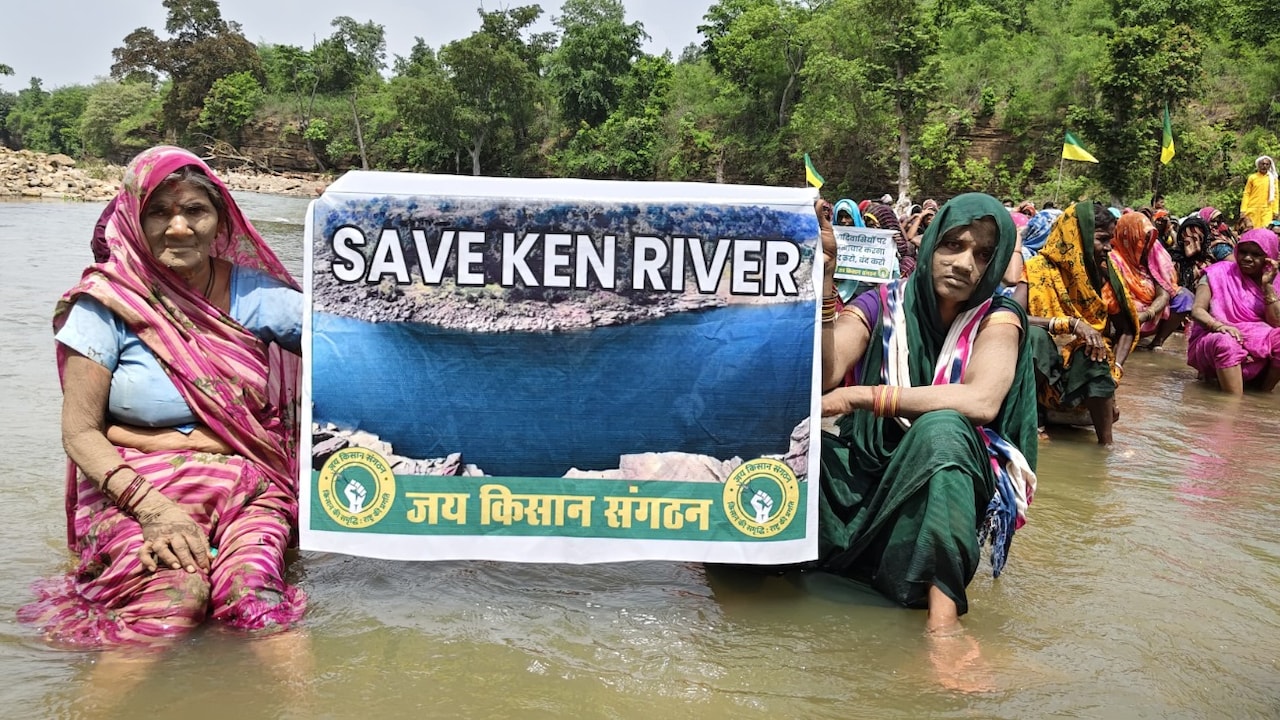
Women from tribal communities protest the KBLP.
Their argument is simple.
If they must leave, then the government must ensure dignified and sustainable rehabilitation, i.e., permanent alternative sources of income and housing, as well as access to basic infrastructure, including that guaranteed under the Constitution.
This includes education and healthcare, drinking water and sanitation, and electricity.
The protesters are steadfast in their demands. "We want to tell the administration… if our demands aren't met this time, we will hang ourselves under this bridge…" one man said.
What is the Ken-Betwa project?
The Ken-Betwa Link Project (KBLP) is India's first major river interlinking initiative. The idea is to transfer water from one river basin – the Ken – to the other via underground pressurised pipes.
The estimated cost of doing so is a staggering Rs 44,605 crore.
But, the government has said, when it is completed the KBLP will irrigate 10.62 lakh hectares of agricultural land, provide drinking water to 62 lakh people, and generate 130 MW of power.
These are not insignificant development milestones.
But for the tens of thousands of men, women, and children who will be affected by this project, necessary though it is, their struggle to survive afterwards must be taken into account. And that struggle will continue, in public till the news cycle ends and away from the spotlight thereafter. But it will continue, as they have made it clear, till the government helps them.
Politics too
Meanwhile, where there are protests and civil society issues at play, politics is too.
Congress MLA Umang Singhar, the Leader of the Opposition in the BJP-ruled state, met some displaced families and protesters and listened to their grievances. He told them their worries would be raised - forcefully - in the next Assembly session and Chief Minister Mohan Yadav's administration would be pushed to ensure rehabilitation and compensation.
The next session begins in three days, i.e., July 20.
Just what the state will do when presented with this issue by the opposition is unclear. Will they acknowledge and answer the people whom they serve, and will displaced families receive rehabilitation and livelihood guarantees? Or will it all just turn into a political squabble, with the lives of the affected people in Chhatarpur district relegated to the backburner?
With inputs from Arvind Kumar Tiwari
-
Opinion | Pakistan's Iran Problem Isn't Going Anywhere

Despite its glowing successes, and for all its mediation efforts, Pakistan's toughest audience may be in Iran itself
-
Opinion | Why Britain Is Finding It So Hard To Deport A Pakistani 'Grooming Gang' Leader
Shabir Ahmed, a UK-Pakistan dual national, lost his British citizenship after his conviction more than two decades ago. Now, Pakistan is refusing to take him back.
-
Beyond Low Cost: Why Foreigners Choose India's Healthcare Over The West
India's medical tourism industry is estimated to be worth $12.32 billion in 2026. It is growing much faster than the country's overall tourism sector.
-
Opinion | Is Saudi Arabia Now Quietly Switching Sides In US-Iran War?
The Saudi presence at the Ayatollah's funeral as well as its refusal to join America's 'Project Freedom' points to a quiet shift away from its ally, the US.
-
Opinion | China Now Has 7 Of The World's 10 Biggest Banks, And That Should Worry India
Seven of the world's ten largest banks are now headquartered in China. Twenty-two Chinese banks figure in the top 100. No Indian bank comes anywhere close.
-
Delhi's New Policy Paves Way For High-Rises. Architects Flag One Big Risk
Without parallel investments in roads and urban design, higher density could simply place more pressure on already strained neighbourhoods.
-
Opinion | A Quiet Indo-Pacific Revolution Is Underway, And India Is At Its Centre
America's unpredictability has finally done what the China threat never could for the Indo-Pacific
-
Opinion | Trump's Quiet Turkey 'U-Turn' Has Loud Consequences For India
In a stunning policy reversal, Trump has decided to sell America's F-35 jets to Turkey, a staunch Pakistan ally and its closest defence supplier
-
Rs 1,160 Crore Rice 'Scam' Widens: 56 Mills, 22 Ethanol Plants Under Scanner
Investigators are trying to establish how much of the nearly 5 lakh metric tonnes of government rice allocated for ethanol production was actually converted into ethanol, and how much may have been diverted through private mills before returning to government warehouses.