





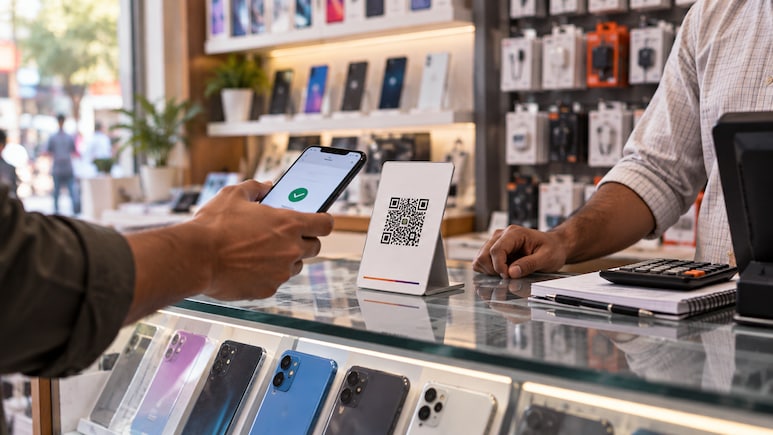
The Centre's decision to introduce a Merchant Discount Rate (MDR) on selected high-value Unified Payments Interface (UPI) transactions from October 15 has prompted questions over whether the move amounts to a new tax on digital payments.
The government and the National Payments Corporation of India (NPCI), which operates UPI, have said that MDR is a merchant-side payment-processing charge, not a tax, cess or surcharge. The money is not credited to the Government of India's Consolidated Fund and is instead distributed within the payments ecosystem.
Under the new framework, a 0.4 per cent MDR will apply to specified person-to-merchant (P2M) UPI transactions above Rs 2,000, with the charge capped at Rs 300 for transactions of Rs 75,000 and above. Person-to-person transfers will remain free, while merchant payments of Rs 2,000 or less will continue to carry zero MDR.
The government says the change is intended to provide a more sustainable funding model for an infrastructure that now handles tens of billions of transactions every month. NPCI's latest statistics show that UPI processed 24,508.96 million transactions worth about Rs 29.82 lakh crore in August 2026 alone.
Here's a factbox:
- MDR is NOT a tax.
- MDR is NOT a Cess or Surcharge.
- Not a single rupee of MDR goes to the Government of India.
- MDR does not go to the Consolidated Fund of India.
- MDR stays within the payment ecosystem.
- Around 96 per cent of all UPI merchant transactions remain unaffected.
Same MRP, Any Mode
The introduction of MDR does not change the Maximum Retail Price of a product. A product priced at Rs 5,000 remains a Rs 5,000 product whether the customer pays using UPI, a debit card or another payment method. The argument put forward by the government is that merchants have historically absorbed the MDR associated with debit-card transactions within the same MRP. The MDR is a cost of processing the payment rather than a tax imposed on the underlying purchase.
What Happens Above Rs 2,000?
The new charge applies only to specified person-to-merchant transactions above Rs 2,000.
- Only specified Person-to-Merchant (P2M) transactions above Rs 2,000 attract MDR.
- Normal rate: 0.4 per cent
- Maximum MDR: Rs 300 for transactions of Rs 75,000 and above.
- Essential sectors such as railways, telecom, insurance, fuel and agricultural inputs: only Rs 5 flat MDR above Rs 2,000.
- The customer does NOT pay MDR. Banks have been advised to ensure that merchants do not pass it on to customers.
Simple Rs 5,000 Example
Consider a Rs 5,000 purchase. Under the new UPI framework: 0.4 per cent of Rs 5,000 = Rs 20
The merchant-side MDR would therefore be Rs 20.
For comparison, a credit-card MDR of 2 per cent on the same Rs 5,000 transaction would amount to: 2 per cent of Rs 5,000 = Rs 100
Yet the product itself remains priced at Rs 5,000.
Where Does The 0.4 Per Cent Go?
For eligible UPI merchant transactions, the proposed distribution of the MDR is - 40 per cent with the issuing bank and the customer's bank, 30 per cent with the merchant acquirer, the merchant's bank or payment gateway, 20 per cent with the UPI app/TPAP, the third-party application provider and 10 per cent with the payer PSP bank, the sponsoring bank of the UPI application
The government does not receive a share of the MDR as tax revenue.
Why Introduce MDR Now?
The principal argument is that UPI has grown into a system operating at a scale far beyond that envisaged when the zero-MDR regime was introduced.
The network has to support servers, bandwidth and payment infrastructure, among other things. The government says a sustainable revenue mechanism is needed if UPI is to continue expanding without relying entirely on annual budgetary support.
UPI had 55.49 crore users by June 2026, according to the Ministry of Finance.
Why The Rs 2,000 threshold?
The threshold is designed to preserve zero MDR for everyday, low-value payments while introducing a charge on higher-value commercial transactions.
Government data indicates that the vast majority of P2M transactions are small-value payments.
Only around 4 per cent of P2M transactions were above Rs 2,000, according to the government's breakdown, although those higher-value transactions represented a much larger share of the value flowing through UPI.
Small Merchants Remain Protected
Small merchants collecting up to Rs 1 lakh a month through UPI QR codes remain exempt from the new MDR.
UPI QR payments to merchants in rural and semi-urban areas will also remain free under the framework. Five per cent of MDR collections is to be directed towards a dedicated fund intended to expand UPI acceptance among small merchants.
Track Latest News Live on NDTV.com and get news updates from India and around the world

