





They came, they deliberated and then got together for a big BRICS family photo.
Prime Minister Narendra Modi, in centre, was flanked by Russia, China and other world leaders on Day 2 of the summit as cameras went about their business.
#WATCH | BRICS Summit 2026 | Delhi: Prime Minister Narendra Modi poses for a Family Photo with world leaders at Bharat Mandapam on Day 2 of the BRICS Summit.
— ANI (@ANI) September 13, 2026
(Source: DD News) pic.twitter.com/JW0iAqFIJb
Members of the 11-nation BRICS group including China, Russia, Iran and India called for calm in the Middle East in New Delhi on Saturday, overcoming earlier divisions to issue a joint statement.
Read: In BRICS New Delhi Declaration, Condemnation Of War, Tariffs
Chinese President Xi Jinping, who joined Russian, Iranian, Indian and other leaders in India's capital, told the summit that the Middle East war "does not serve the common interests of the international community".
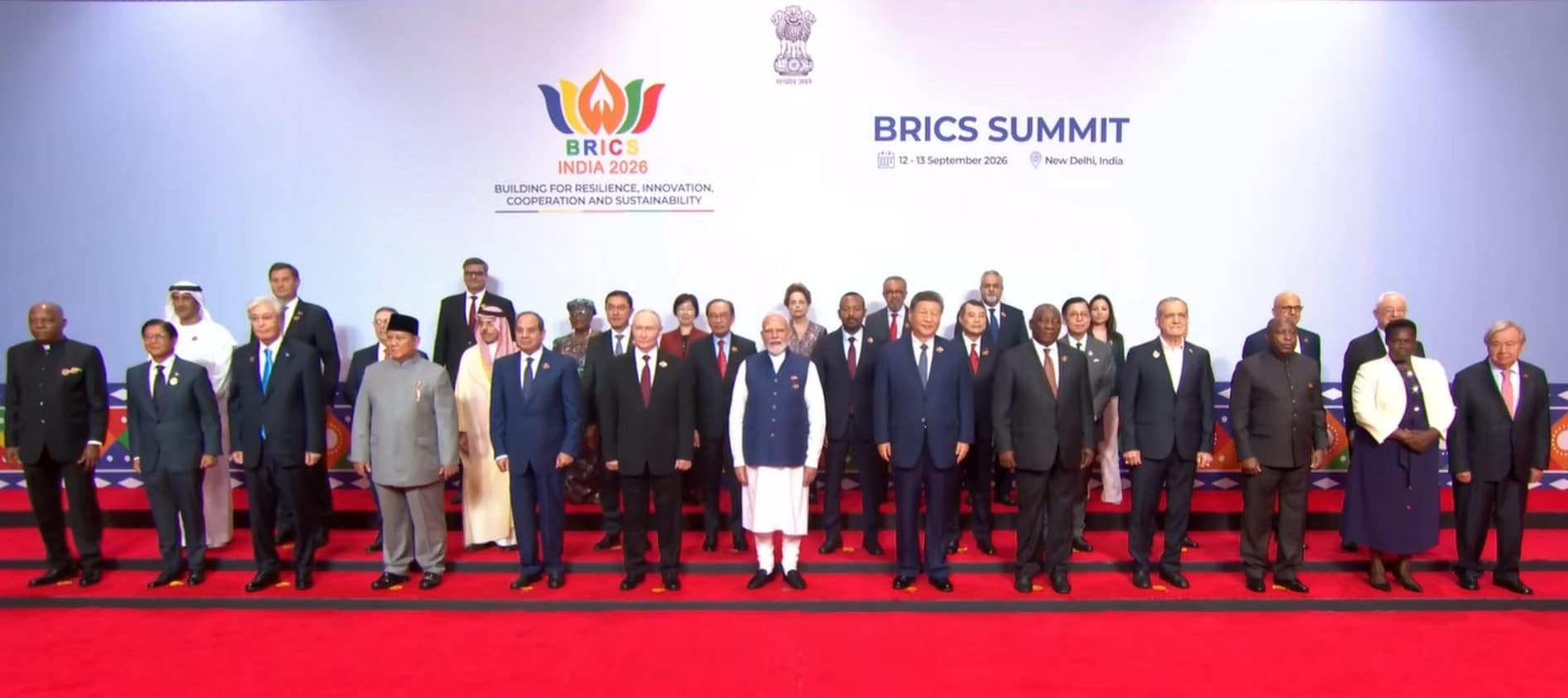
BRICS leaders posing for a group photo on Day 2 of the summit in New Delhi
Foreign ministers of the BRICS grouping had failed to agree on a joint statement when they met in New Delhi in May, with Iran, Saudi Arabia and the United Arab Emirates divided over the war that began with US-Israeli strikes on February 28.
But leaders issued a statement on Saturday after intense diplomatic efforts by host India, as the bloc seeks to bolster its global influence and address conflict, trade turbulence and energy security.
"We express deep concern over the continued escalation of tensions in Middle East/West Asia," the joint statement said, adding the countries "call for exercising maximum restraint, as well as avoiding actions that could further aggravate the situation".
BRICS was created in 2009 as a forum for major emerging economies seeking greater influence in institutions dominated by Western powers.
"No member has raised any objection. The New Delhi Declaration 2026 is adopted unanimously," PM Modi said, announcing the milestone consensus.
Iran's Pezeshkian attended the summit shortly after warning that the Middle East does not need the United States to be a "regional policeman", with the two countries at war and tensions threatening the vital Strait of Hormuz.
Pezeshkian met with Abu Dhabi Crown Prince Khaled bin Mohamed bin Zayed Al Nahyan on the summit sidelines
India is currently chairing BRICS in 2026 under the overarching theme "Building for Resilience, Innovation, Cooperation and Sustainability".
Addressing the global security landscape, the declaration delivered a strong condemnation of terrorism in all its manifestations, encompassing cross-border terrorist activities, terrorist financing networks, and safe havens.
It specifically censured the April 22, 2025, terror attack in Jammu and Kashmir, while championing zero tolerance, strict accountability, and the accelerated adoption of the UN Comprehensive Convention on International Terrorism.
Expressing these commitments, the document stated, "We reaffirm our commitment to combating terrorism in all its forms and manifestations, including the cross-border movement of terrorists, terrorism financing and safe havens."
Reaffirming its adherence to core principles of mutual respect, sovereign equality, solidarity, inclusivity, and consensus, the bloc committed to deepening collaboration across its political and security, economic and financial, and cultural and people-to-people pillars.
On regional stability and conflict resolution, member states underscored the critical necessity of proactive conflict prevention measures that tackle underlying root causes, reiterating a dedication to settling disputes through dialogue, consultation, and diplomacy.
Financial crime and transnational trafficking also drew sharp focus, with the bloc voicing deep disquiet over illicit financial flows tied to narcotics offences, firearms trafficking, terror financing, and organised crime, while urging enhanced cross-border cooperation to intercept illicit funds.
Warning against these protectionist policies, the declaration noted, "We voice serious concerns about the rise of unilateral tariff and non-tariff measures which distort trade and are inconsistent with WTO rules."
The framework reaffirmed allegiance to a WTO-centred multilateral trading framework, demanded the immediate revival of a fully operational, two-tier binding WTO dispute settlement mechanism alongside the appointment of Appellate Body members, and denounced unilateral economic and secondary sanctions.
Condemning these punitive actions, it stated, "We condemn the imposition of unilateral coercive measures that are contrary to international law," while urging their termination since they "undermine international law and the principles and purposes of the UN Charter."
Track Latest News Live on NDTV.com and get news updates from India and around the world

