





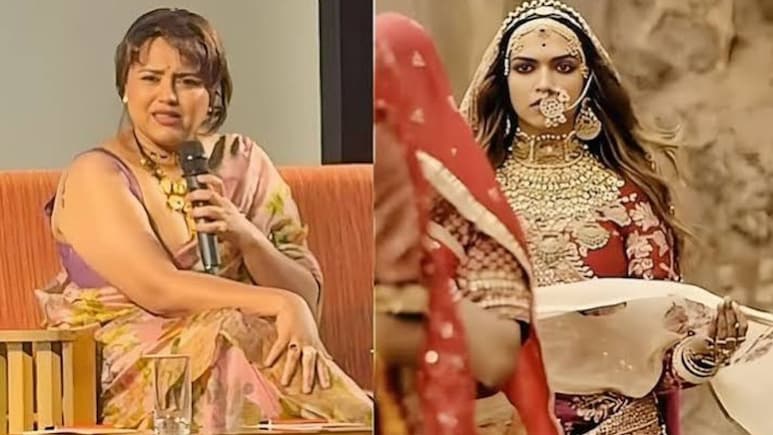
Incensed by her comments against the 'jauhar' tradition as shown in the 2018 movie 'Padmaavat' -- of women self-immolating when enemy armies invade their kingdoms -- the Bharatiya Janata Party (BJP) has accused actor Swara Bhasker of "insulting" women.
Bhasker had at a recent event said such a tradition implies that "I would feel like a coward [if] I didn't kill myself to 'save my honour'". She'd added, "Is that what you want to tell in a society like ours where there is anyway a rape epidemic? Is this what we want to tell our survivors, that you didn't deserve to live?" After online backlash, she shared a video clarifying that she did not use the word "coward" for Rani Padmavati, the central character played by Deepika Padukone in the Sanjay Leela Bhansali movie. She'd written an open letter to Bhansali at the time of the movie release too.
The BJP has now accused her of speaking in "someone else's voice", not detailing who or what that might be. Responding to a question at a press conference, BJP spokesperson Gaurav Bhatia deployed wordplay with her name Swara, which means voice or tone, saying, "You just mentioned a person whose 'swara' (voice) is distorted. This person has a voice that is fed to them from above." On her statement specifically, Bhatia said, "I believe no such comments should be made, and it is essential that every woman respects other women." Krishna Kumar Singh, state BJP leader in Bihar, has lodged a complaint with the police too. He has accused her of making derogatory statements against Hindu society and Rajput women.
Criticism also came Bhasker's way from the Rajput organisation Karni Sena, which at the time of the movie's making and release had opposed it, alleging that director Bhansali was showing Padmavati in poor light. On Bhasker's comments, Kirthi Rathore, women's wing chief of Karni Sena, told News18, "She should mind her language. Given the cheapness she is exhibiting while sitting at this level, she must understand that if you insult our Hindu female warriors, the female warriors of Sanatan, in this manner, and point fingers at their sacrifice and bravery, the Karni Sena will never forgive you." She then accused her of not speaking on regressive traditions in Islam but singling out "Hindu traditions".
The climactic scene in 'Padmaavat' shows Rani Padmavati leading the women of Chittor in a mass act of self-immolation by fire to avoid capture and abuse by Alauddin Khilji's invading army. The movie is, at its core, based on a famous 16th-century epic poem of the same name written by the Sufi poet Malik Muhammad Jayasi in 1540.
Track Latest News Live on NDTV.com and get news updates from India and around the world

