





India's automotive market is navigating multiple transitions, from EV adoption to E20 petrol rollout. The instability has kept the vehicle owners and buyers on their feet. While the government has apprised of a potential mileage drop due to E20 blending, it has also confirmed that a few parts need to be changed in BS-III vehicles. But, what are those parts and how do they get damaged?
"Only in case of testing done on BS-III vehicles introduced from 1st April, 2005 and manufactured prior to 2016, some rubber parts and gaskets may require replacement, which can be easily managed during routine servicing regime of the vehicle," Nitin Gadkari, Union Minister of Road Transport & Highways told Rajya Sabha on July 29, 2026.
Which Materials Get Damaged?
Many plastic materials and elastomers - polymers that display rubber-like elasticity - used in the fuel-system components behave differently when exposed to petrol with E20, compared to E10 or lesser blend. These materials are used in seals, hoses, gaskets, O-rings, pipes, fuel hoses, fuel-pump parts, etc.
E20 exposure led to greater hardening, loss of strength & flexibility, and swelling in some parts of older vehicles, including the BS-III ones, according to the study carried out by the Automotive Research Association of India (ARAI) in 2021. The study was carried out when E20 fuel rollout was still in the pipeline.
"Significant drop in elongation was observed in Polyvinyl chloride/Nitrile butadiene rubber blend
(PVC/NBR) with 59% in E20 against 41% in commercial gasoline, followed by Epichlorohydrin with 58% and 46% in E20 and commercial gasoline respectively," the ARAI report said.
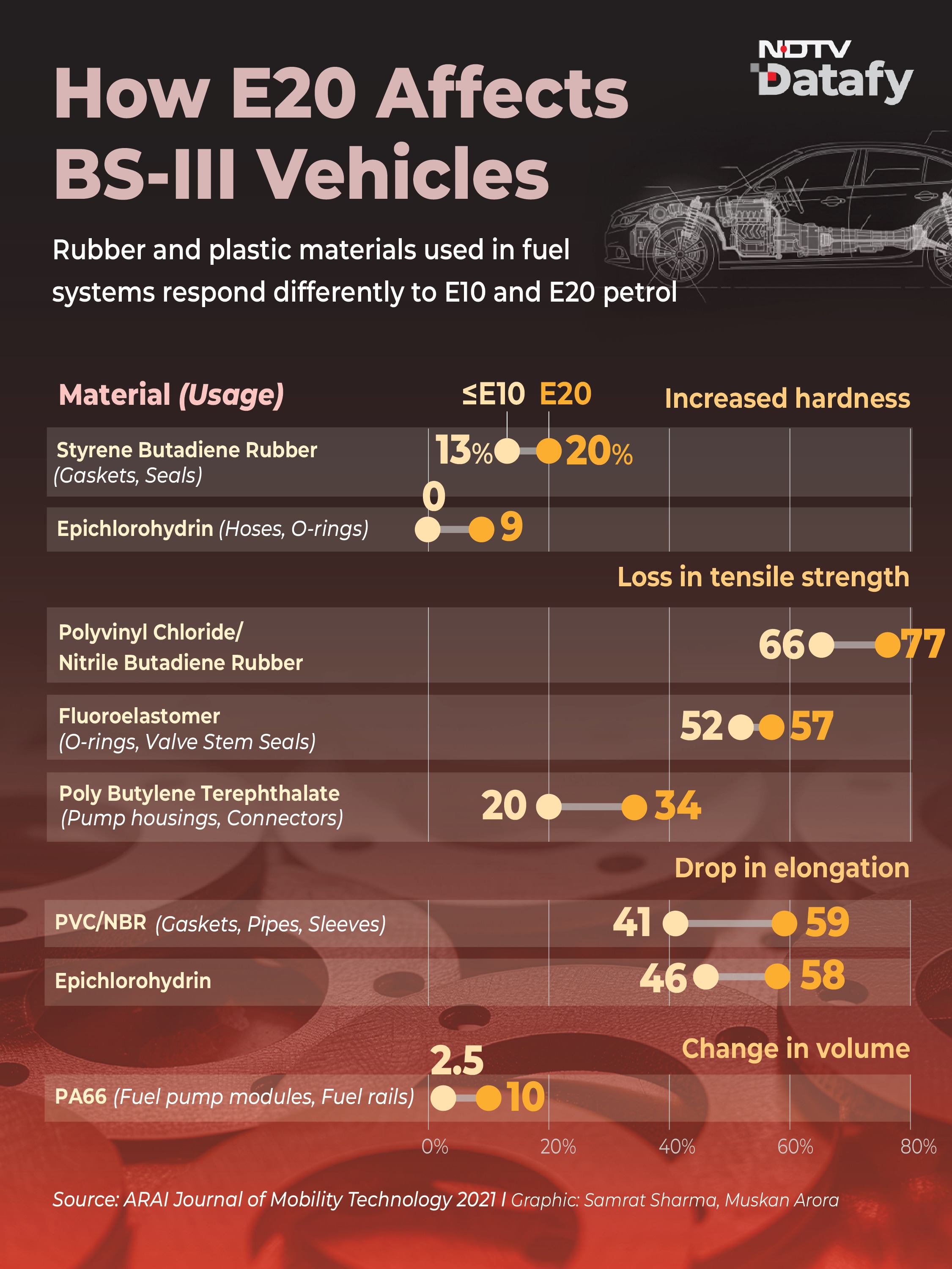
The researchers also noted that the reduction in tensile strength was greater in E20 than in conventional petrol for Poly Butylene Terephthalate (PBT), a material used in fuel-system components. Meanwhile, Polyamide 66 (PA66) recorded a significantly higher increase in volume after exposure to E20, indicating greater fuel absorption and swelling.
Why Do Parts Need Replacement?
These material changes can have practical implications. Increased hardness can make rubber components brittle and more susceptible to cracking. A fall in tensile strength weakens the material and reduces its ability to withstand mechanical stress. Lower elongation means the component becomes less flexible, while volume expansion can lead to swelling, dimensional changes and sealing issues.
As India deepens its ethanol-blending programme, E20 may accelerate wear in some fuel-system components of older BS-III vehicles, making periodic replacement of rubber parts and gaskets a small but important cost of the fuel transition.
Track Latest News Live on NDTV.com and get news updates from India and around the world

