'A Breaking Point': An Open Letter To Nandan Nilekani On How To Fix India's Exams
Congress MP Shashi Tharoor offers a radical blueprint to the man leading the Centre's exam reforms task force.
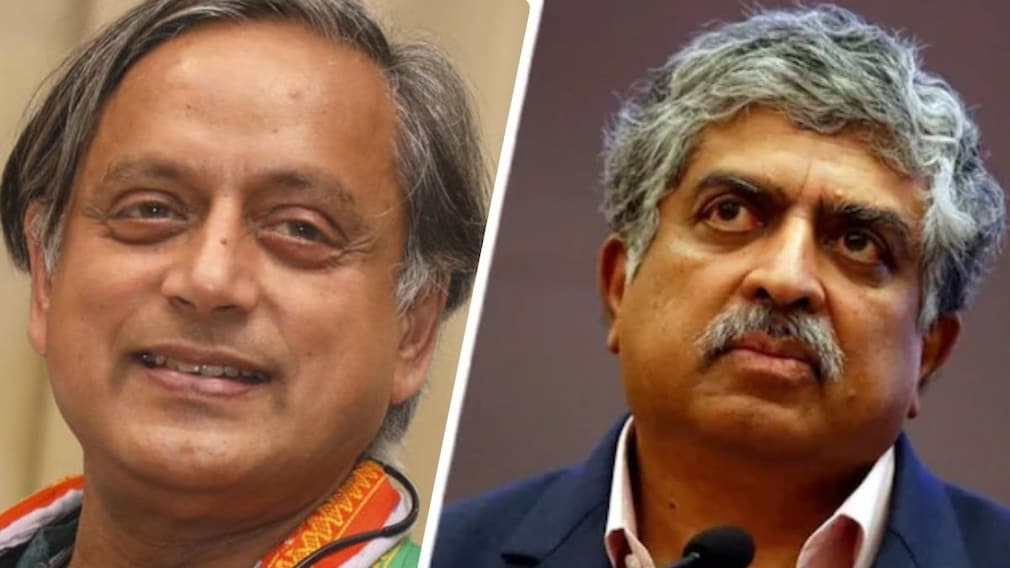
My dear Nandan,
I am one of those who is delighted that you have been asked to lead a committee to propose reforms in our nation's examination system. Though I am conscious that another such committee was named after a series of paper leaks in 2024, led by Prof K. Radhakrishnan, and made 101 recommendations, most of which have not been implemented, I would like to believe that whatever you come up with is more likely to retain the government's attention. Since there is no indication that your committee plans to consult Parliament or its members, as representatives of the people, for their views, I am offering you a few ideas here as a well-meaning citizen.
You know that this is a moment of profound angst and unprecedented disillusionment among India's youth. Across the country, millions of young men and women, who have spent the prime of their lives buried under mountains of test preparation, sacrificing sleep, health, and family resources, only to be betrayed by the failings of the system, took to the streets. Their anger was not merely a reaction to isolated paper leaks or administrative blunders; it was the inevitable breaking point of a system that has become structurally obsolete, morally exhausted, and intellectually deadening.
Go Beyond Stopgap Solutions
India's youth do not lack ambition, intellect, or resilience. What they lack is an educational ecosystem that matches their promise. We have created a high-stakes, hyper-competitive bottleneck where a candidate's entire youth is judged by a single, high-stress, high-volume multiple-choice exam administered over a few gruelling hours. When that fragile mechanism breaks down, due to administrative malfeasance, corruption, or institutional rot, it shatters the faith of an entire generation in the promise of Indian meritocracy. If we are to transform this crisis into an opportunity, we cannot settle for incremental fixes or temporary committee reports. We need a fundamental reimagining of how we assess talent, foster higher education, and prepare our youth for the twenty-first century.
The core vulnerability of our current national testing regime (whether for university admissions or professional qualification) is its centralised, single-day, high-stakes design. When three million students must sit for a test simultaneously on a single Sunday, the logistics create massive vectors for paper leaks, server crashes, and administrative failure. Moreover, it is pedagogically cruel: a sudden illness, panic attack, or family emergency on exam day (or even a bad traffic jam on the way!) can set a student back by an entire year. India must, therefore, transition to a continuous, modular, and computer-adaptive testing framework modelled on the GRE and SAT. By establishing state-of-the-art, secure testing centres across every district, where standardised exams can be administered multiple times throughout the year, we can allow students to submit their highest score for admission applications. This immediately de-escalates youth anxiety, dismantles the toxic pressure-cooker environment, and removes the single-point-of-failure vulnerability that makes paper-leaking cartels so lucrative. Paired with dynamically generated question banks powered by secure cryptographic technology, we could ensure that no two candidates at the same centre would receive the exact same question set, rendering physical paper leaks structurally impossible.
The 'Thinking' Student
Furthermore, our modern national entrance tests largely evaluate high-speed pattern recognition and rote recall, rather than critical thinking, problem-solving, or deep conceptual comprehension. This narrow focus has spawned a predatory, unregulated multi-crore-rupee coaching industry that acts as a shadow education system, favouring affluent urban students who can afford expensive test-prep factories while penalising talented rural youth or students from poorer families. I have long been urging our teachers not to teach students "what to think", but rather "how to think". But that preaching falls on deaf ears if the exam system only rewards those who have "mugged up" preparation material and learned how to regurgitate it in the exam hall. We must not only reform the exam papers and procedures, as I have suggested above, but broaden our evaluation criteria by adopting a holistic admissions matrix. Higher education institutions should weigh entrance exam scores alongside secondary school performance, creative and analytical writing assessments, and maybe even verified extra-curricular activities and community contributions. Entrance exams themselves must be redesigned to test core analytical reasoning and domain-specific problem-solving, rather than requiring students to solve hundreds of complex problems under extreme time-pressure.
Testing reform will achieve little, however, if the destination, our universities, remains stagnant. Higher education institutions across India are bogged down by rigid, outdated syllabi imposed by over-centralised regulatory bureaucracies, leaving graduates ill-equipped for a rapidly evolving global economy. We must grant genuine financial and administrative autonomy to top-tier state and central universities, enabling them to design interdisciplinary curricula, introduce cutting-edge fields like artificial intelligence, climate science, and advanced biotechnology, and form direct industry partnerships. Every undergraduate programme must integrate mandatory internships in the "real world", laboratory research, or community-based field projects, ensuring that a degree signifies practical capability rather than mere attendance.
The Post-Exam Reckoning
A significant driver of students' frustration is the lack of employment opportunities once they finish their studies, with India facing the world's highest graduate-unemployment numbers at 40%. One place the government can start is to deal with the desperate bottleneck for public sector employment, where tens of thousands of university graduates apply for a handful of clerical positions. This reflects a structural mismatch: our higher education system grants degrees that fail to convey market-relevant skills, driving youth toward public sector exams as their sole sanctuary for economic security. To address this structural imbalance, we should first urgently fill all existing public sector vacancies with those who have cleared previous examinations but languished on pending lists. Second, we should streamline public recruitment by replacing dozens of fragmented, overlapping recruitment tests with a unified, biannual National Public Service Aptitude Assessment, also on the model I have previously outlined. Meanwhile, civil service roles should be redefined to explicitly require technical abilities and functional skills, rather than relying on hyper-competitive elimination exams that test trivial general knowledge.
Listen To The Young
Finally, the crisis of faith among our youth stems from a complete lack of administrative accountability when systems fail. Heads must roll for the repeated failures of the last few years, especially 2024 and 2026. It is not enough to hold one Minister morally responsible. Others down the chain must also pay the penalty for maladministration, or worse, malfeasance. And to ensure this doesn't happen again, the system must be fixed. When exams are cancelled or compromised, state agencies routinely issue vague statements while leaving students in financial and emotional limbo. We must enact strict legislation establishing a statutory National Testing Standards Act, creating a clear legal "duty of care" that is owed by testing agencies to candidates. This framework should mandate financial compensation for students affected by administrative cancellations, enforce strict timelines for grievance redressal, and assign severe criminal liability for institutional negligence or corrupt practices. Complemented by an independent Ombudsman for Educational Examinations, completely detached from the Ministry and testing agencies, we can audit security protocols, investigate candidate complaints, and publish annual transparency reports that restore public faith.
The young people who protested at Jantar Mantar and across our nation were not asking for unearned privileges or lowered standards. They were asking for fairness, transparency, and a system that respects their dignity and hard work. By replacing high-stress, leak-prone testing rituals with a modern, modular, and holistic educational framework, India can restore trust in its public institutions and unleash the true potential of its young demographic. The choice before us is clear: we can continue to patch up a collapsing, century-old apparatus, or we can build a resilient, world-class education system worthy of India's future. You can help our government make that choice.
All the best, Nandan!
(Shashi Tharoor has been a Member of Parliament from Thiruvananthapuram, Kerala, since 2009. He is a celebrated author and a former diplomat)
Disclaimer: These are the personal opinions of the author
-
Opinion | India Faces A BRICS Challenge. Can It Find A Way Through?

The Delhi Summit is being held at a challenging time. Such circumstances have not been encountered since the BRICS Summits started in 2009 in Russia
-
Opinion | Why The Jauhar Scene In Padmaavat Needs To Be Seen For What It Does
The practice of 'jauhar' was certainly abolished long ago. But that does not mean that it should be romanticised or glorified in mass culture.
-
Opinion | Sachin Pilot's Long Wait Is Over. Can Congress Finally Use Him?
The grand old party is now betting that the man who turned 'waiting' into a virtue can deliver Punjab
-
Ground Report | Sunlight Is A Luxury In Delhi Students' Hub Where Building Collapse Killed 7
The civic infrastructure in Delhi's Satya Niketan hasn't caught up with the pace of development and appears to be crumbling under the weight of the influx of tenants and the greed of landlords.
-
Mayawati's Tough Love: Nephew Akash Anand Benched Again. What It Means For BSP
Akash Anand, the 31-year-old foreign-educated nephew of BSP boss Mayawati, finds himself out of favour, for at least the third time in three years, with the latest turn coming in Lucknow on September 3.
-
Blog | Why You Should Care Whether Schrodinger's Cat Is Dead Or Alive
Imagine going on a romantic Alpine getaway and returning with the equation that runs the modern world. The only snag: nobody can quite agree on what it says about reality.
-
Promote, Punish, Repeat: Decoding Mayawati's Akash Anand Puzzle
The development in the BSP is unprecedented. Never before has any Indian party elevated a family member and dumped him or her unceremoniously thrice within a span of three years.
-
Opinion | Nepal Needs $5 Billion To Rebuild. World's Climate Fund Doesn't Have Even 10% Of It
The fund caps support at USD 20 million per project; Nepal needs two hundred times that. And the board is not scheduled to sit until December.
-
Opinion | The Rise Of Indians In US Is Making Some Americans Very, Very Angry
A new report released yesterday shows how Indians are now among the biggest targets of racist attacks in America.
-
Opinion | China, Pak, A Stalled India Visit: How Signals From Bangladesh Are Getting Louder
A fighter jet deal with China, interest in Pakistan's military bloc, and a 'stalled' visit to India - all in a month. Bangladesh's drift is getting harder to ignore.