






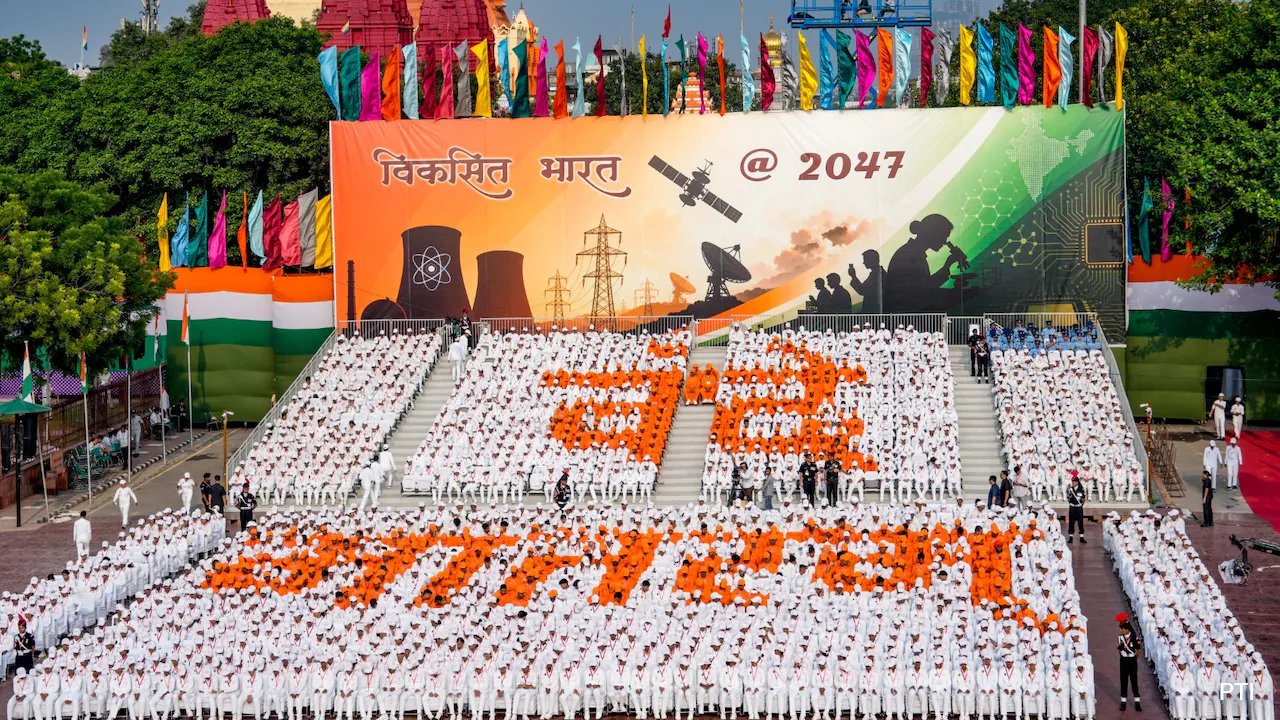
India marks its 80th Independence Day today, and with it, eight decades of a nation's argument with its own destiny. Every anniversary is an occasion to celebrate; this one is an occasion to reckon, with the battles fought within our borders and beyond them, with the price paid for the freedom we now take for granted, and with the distance travelled from a fragile young republic to a civilisation that once again speaks in its own voice.
There was a time, not so long ago, when India was reduced in the Western imagination to a curiosity: the land of snake charmers, a country whose poverty was assumed and whose potential was doubted. Visitors from the West arrived expecting to be unimpressed and often were. We had no seat at the high table of diplomacy; at best, we were permitted to stand at its edge, non-aligned by policy and, in truth, unaligned with power itself. The world's trajectory was decided elsewhere. India watched and waited.
That India no longer exists.
Today's India is not non-aligned; it is multi-aligned, courted rather than courting. We are among the world's five largest economies, and when we choose to deepen economic ties with a nation, the relationship reshapes not just our future but theirs. We no longer wait at the edge of the table; we help set its terms. The West, out of old habit, still offers its sermons on democracy. But India's answer is no longer rhetoric, it is our young population building, launching, and governing a future of its own making. Indian private enterprise now reaches into space without waiting on the state's permission or purse. A generation once caricatured for its restlessness is, in fact, laying the foundations of what may well be remembered as the Indian century.
None of this arrived without cost.
For nearly four decades, half of independent India's life, the nation has fought a war that was never formally declared: Pakistan-sponsored terrorism in Jammu and Kashmir and beyond. From Pulwama to Pahalgam, the intent behind these attacks was never only to kill civilians and spread fear. It was to slow India down, to choke a rising power in its own blood before it could rise further. Pakistan, having failed its own people, chose instead to export chaos to ours. That strategy has not gone unanswered.
The surgical strikes of 2016, following the Uri terror attack, and the Balakot airstrikes of 2019, following the Pulwama attack, announced a new doctrine of response. But Operation Sindoor in 2025, launched after the Pahalgam attack, marked a paradigm shift, a demonstration that India's patience has limits, and its reach does not. The image of a base near Rawalpindi in flames is one that Pakistan's military establishment will not soon forget. India intends that it shouldn't.
Alongside this external vigilance came an internal reckoning. The abrogation of Article 370 in 2019 closed a chapter of manufactured separatism that had defined Jammu and Kashmir for over three decades, opening instead a slow, uneven, but real path toward development and opportunity. Change in J&K was never going to arrive overnight after decades of neglect, but it has, finally, begun to arrive.
Elsewhere, in the forests and hinterlands of the Red Corridor, another war quietly turned. For years, Bastar in Chhattisgarh stood as the self-declared capital of a "liberated zone" carved out by Maoist violence, its toll measured in the lives of security personnel and innocent villagers alike. Across Chhattisgarh, Maharashtra, Jharkhand, Bihar and Andhra Pradesh, that insurgency has been broken at the spine. What remains is a fading echo, kept alive more by memory than by strength, and it is only a matter of time before Maoism exists solely in history books, a cautionary tale for both the state and the citizen.
Even as India secured its interior, it opened itself to the world, not with hesitation but with the confidence of Vasudhaiva Kutumbakam, the ancient conviction that the world is one family. Many nations are signing trade agreements and partnerships with India, not merely for access to its markets but because they trust it to deliver on its word. In a world fractured by conflict and uncertainty, India has become something rarer than a superpower: a dependable one.
There is something fitting, then, that today, for the first time in its history, Vande Mataram was sung from the ramparts of the Red Fort, marking a hundred and fifty years since it was first written. It is not merely a song. It is a vow renewed: that a civilisation once written off as fated to poverty and fragmentation would instead endure, rebuild, and rise, on its own terms, in its own time.
Eighty years is long enough to have earned pride and short enough to remember what it cost. Every soldier who stood at Uri, Balakot, and in the shadow of Pahalgam; every policeman who patrolled Bastar's forests when few dared to; every ordinary citizen who kept faith with the republic through its most uncertain decades - they are the reason this anniversary is not just a date on the calendar but a debt we carry.
So today, we do not merely wave a flag. We bow to the soil, to the sacrifice, and to the Mother who asked nothing of us but that we believe in her.
Here's a stanza from Vande Mataram:
Tvam hi durga dashapraharanadharini,
Kamala kamaladalaviharini,
Vani vidyadayini,
Namami tvam,
Namami kamalam amalam atulam,
Sujalam suphalam mataram. Vande Mataram.
(You are indeed Durga, bearer of ten weapons; you are Kamala, who dwells upon the lotus; you are Vani, giver of knowledge. I bow to you, stainless, incomparable, lotus-like. O Mother, rich in waters, rich in fruit, I bow to thee.)

