






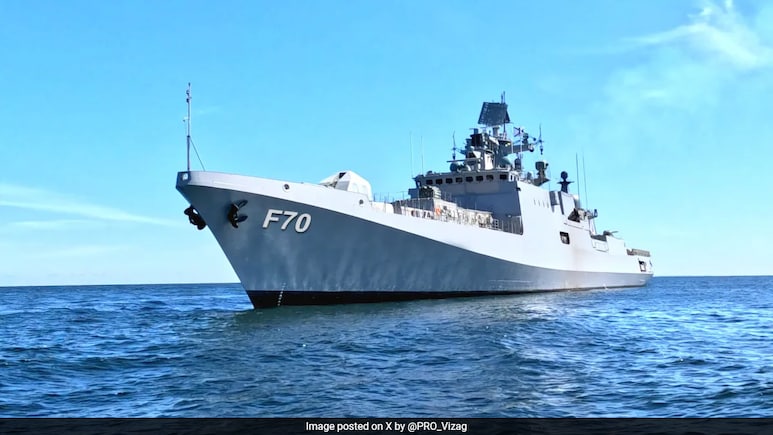
India's warship-building story is progressively one of indigenous design, construction, and systems integration. But an uncomfortable contradiction lies at the heart of this progress: India can build sophisticated warships, yet remains dependent on foreign sources for some of the most critical machinery that actually makes those ships move - marine engines.
That dependency is strategically more serious. A propulsion system is not simply another subsystem. It is the ship's power plant, endurance mechanism, and most complex marine tech, which is dominated by a few among the advanced countries. If the propulsion chain is vulnerable to export restrictions, sanctions, IP controls or foreign supply disruptions, the combat capability of an otherwise indigenous warship can be seriously compromised.
Moreover, it symbolises India's maritime ambition, its next era of economic growth, with a marine economy at its core. For the Indian Navy, therefore, Atmanirbharta in shipbuilding goes beyond the hull, weapons, and sensors, to the elusive marine engine.
For example, take a look at China: "marine engineering manufacturing" is listed as one of the highest-growth industries. So much so that China's marine economy outperformed national GDP growth, surpassing USD 700 billion, up 6% year-on-year, as per its public disclosure.
India now needs a national mission for indigenous marine propulsion - one that moves beyond assembling foreign equipment under licence and develops genuine Indian competence in design, materials, manufacturing, integration, and testing. India Navy (IN) has a roadmap of around 230 surface combatants and submarines by 2037, and all warships need propulsion. So, the urgency is clear.
The Real Gap Isn't Just One Engine
The Indian Navy currently operates a mix of steam, diesel, and gas-turbine propulsion systems. India has developed considerable indigenous capability in steam turbines and smaller diesel engines. The strategic gap becomes much clearer when propulsion is examined subsystem by subsystem.
Marine gas turbines still depend heavily on foreign technology, particularly for core design, hot-section materials, coatings, and turbine tech.
Large naval diesel engines face gaps in power density, reliability, and qualification. Reduction gearboxes remain heavily import-dependent, while advanced shafting, bearings, and propellers need stronger capabilities in precision engineering, vibration control, and cavitation management.
The next challenge is electrification; naval-grade high-power converters, drives, and switching systems need industrial development. Electric propulsion motors require advances in power density, permanent-magnet, and thermal technology management. Integrated Electric Propulsion (IEP) will demand expertise in power management, storage, controls, and system integration. And air-independent propulsion (AIP) needs to be fixed.
Over the next five to 10 years, these areas should be treated as priority technologies for building a truly indigenous naval propulsion ecosystem.
Gas Turbines, The Hardest Test of India's Ambition
The most difficult piece of the puzzle is undoubtedly the marine gas turbine.
Today, the Indian Navy's gas-turbine fleet is based on foreign-origin systems. While India has acquired experience through licensed assembly, inspection, and testing of the GE LM2500 family, that is it.
The more ambitious effort is the Kaveri Marine Gas Turbine, being pursued by DRDO's Gas Turbine Research Establishment (GTRE), as a marine derivative of the Kaveri/LCA engine programme.
This should be treated not merely as another propulsion project but as a strategic technology programme.
A marine gas turbine demands mastery of compressor aerodynamics, combustion, turbine cooling, high-temperature alloys, single-crystal components, thermal-barrier coatings, and digital engine management. The difficult technology lies precisely in these areas.
So vital is the gas turbine that capability could subsequently spill over into aviation, power generation, and other high-temperature sectors in Defence & Aerospace - and beyond.
Diesel Engines to Design Authority
India has a stronger base in diesel engines. Companies such as Kirloskar Oil Engines and Cummins India have established industrial capabilities, and indigenous steam propulsion has also benefited from BHEL.
But naval propulsion demands more than commercial-engine capability. A warship's diesel engine must operate reliably under heavy load cycles, shock and vibration conditions, and long deployment periods. It must deliver high power density while meeting stringent naval requirements for reliability, noise, and thermal management.
A 6 MW engine should become the beginning of an indigenous product family - not a one-off technology demonstrator.
The Gearbox
One of the least visible but most important gaps lies between the engine and the propeller: the reduction gearbox.
Modern naval gearboxes operate under extraordinary mechanical loads. They require precision manufacturing and advanced metallurgy. More importantly, a naval gearbox is a system-integration challenge. It must work with the engine, shaft line, and propeller. This makes the gearbox a particularly difficult technology to acquire through conventional ToT.
Can an Indian company redesign, repair, upgrade, and certify the equipment without going back to the original foreign designer?
If the answer is no, the heavy dependency remains.
Shafting is sometimes treated as relatively straightforward compared with engines and gearboxes. That is misleading. A naval shaft line has to maintain alignment through changing loads and temperatures, while bearings, couplings, and seals must operate reliably over long periods.
For submarines, the stakes are even higher. The same applies to propellers. Future Indian warships and submarines will require sophisticated propulsor designs optimised for efficiency, cavitation suppression, and acoustic stealth.
Here, industry must build up capability in computational fluid dynamics, hydrodynamic modelling, cavitation testing, precision manufacturing, and underwater acoustic measurement.
The objective should be to develop a complete Indian engine-to-propeller design chain, rather than treating each component as an isolated procurement.
Electric Propulsion
Perhaps the biggest opportunity lies not in reproducing yesterday's propulsion architecture but in developing tomorrow's.
Integrated Electric Propulsion is increasingly relevant to future warships because electrical power is becoming as important as mechanical propulsion. Radars, EW systems, directed-energy weapons, unmanned systems, sensors, and combat-management systems will place enormous demands on the ship's electrical architecture.
But Integrated Electric Propulsion requires much more than an electric motor. India will need competence in high-power permanent-magnet motors, power converters and inverters, high-power semiconductor devices, and energy-storage systems.
There is some discussion with the global OEM on this, but it still remains on paper and in military files.
The Navy should not wait for a perfect indigenous IEP system. It should begin creating an indigenous ecosystem now.
The 5-Year Roadmap
In the five-year roadmap from 2026-31, India needs to move from individual projects to a coordinated propulsion mission.
In Phase I, the immediate priorities should be to build the technology base by establishing a National Naval Propulsion Mission. DRDO, the Indian Navy, shipyards, PSUs, and private industry should work for a common technology roadmap rather than independent programmes.
Secondly, push the Kaveri marine gas turbine, where GTRE should receive stable, multi-year funding rather than episodic project financing.
Then, launch indigenous gearbox and shaft-line programmes. Private industry should also be encouraged to develop competing designs rather than merely manufacture foreign drawings.
Lastly, establish an IEP technology demonstrator on a naval platform or a land-based platform that should integrate an indigenous motor, converter, power system, and propulsion control architecture.
By 2028-31, India should target the sea qualification of the indigenous diesel and land-based qualification of the marine gas turbine. In that sequence, the focus should be on the respective parts, such as prototype naval gearbox and shaft-line testing, and an indigenous high-power electric motor demonstrator.
And the objective should be clear: at least one major propulsion architecture should be sufficiently mature to enter a new Indian warship class without depending on foreign design authority.
By 2036, India should aim to have a domestically designed marine gas turbine family for appropriate naval power classes and a family of indigenous high-efficiency naval diesel engines, rather than one isolated 6 MW engine.
Not to forget the early-stage planning of a national propulsion test and certification ecosystem capable of qualifying complete propulsion trains before installation aboard ships.
One reason propulsion programmes take years to mature is that testing is often treated as a downstream activity. It should be the opposite.
Earlier, the test-bed affected India's jet engine programme, where Kaveri needed to be taken to Russia for each validation.
So, most crucially, India needs dedicated land-based propulsion test facilities capable of testing engines, gearboxes, shafting, motors, and complete integrated propulsion trains under realistic conditions.
Here, crucially, DRDO should own the difficult technology, while industry should own the production part.
DRDO should concentrate on the hardest technology barriers - gas turbines, advanced materials, combustion, high-temperature metallurgy, AIP, power electronics, propulsion controls, and other areas where commercial returns are uncertain but strategic importance is high.
The private sector should then be brought into design, engineering, manufacturing, integration, and life-cycle support.
PSUs can contribute where they have genuine competence in heavy engineering, metallurgy, power systems, and precision manufacturing.
Indigenous propulsion should be treated not as another Make-in-India project, but as a strategic national technology mission, with DRDO driving the hardest R&D, industry building scalable manufacturing capability, the Navy providing assured demand, and the government funding the test infrastructure needed to turn prototypes into dependable fleet equipment.
Disclaimer: These are the personal opinions of the author

