




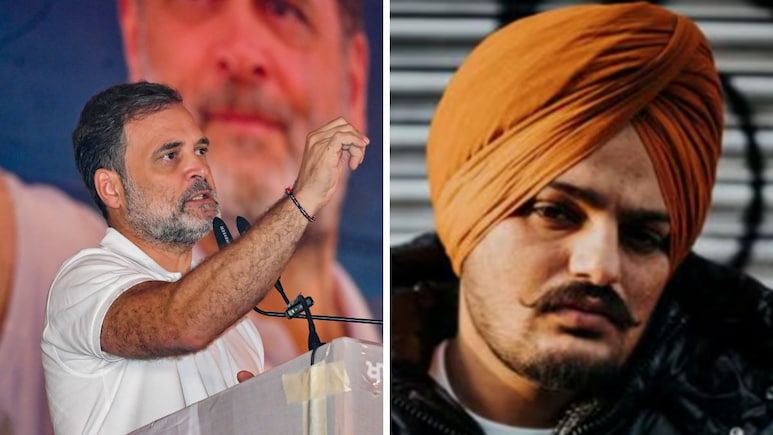
At the Congress Insaaf Rally in Sangrur, Rahul Gandhi reached for one of Punjab's most powerful cultural symbols. Recalling his first meeting with Sidhu Moose Wala, the singer murdered in May 2022, the Leader of the Opposition described him as an extraordinary talent. "He was probably Punjab's most talented singer, who could also one day make a mark in politics," he told the rally. "Punjab's voice used to come out in his songs." Gandhi also invoked the circumstances of Moose Wala's murder, drawing a parallel with the climate of fear he accused the Aam Aadmi Party government of allowing to take hold in Punjab. "The mindset behind shooting Moose Wala in front of everyone without any fear is the same that is prevalent in every corner of Punjab today," he said.
The timing was significant. With Punjab heading towards Assembly elections in 2027, Congress is reaching for a cultural figure whose appeal crossed generations and geographical boundaries. Moose Wala joined the party in December 2021 and contested the 2022 Assembly election from Mansa. Gandhi's personal association with him gives the tribute an added political dimension.
There is, however, a complication. Gandhi cited '295', perhaps the most convenient song in Moose Wala's catalogue for a national political audience. The singer's entire body of work is considerably challenging to accommodate.
Can Congress embrace the man without confronting the politics running through his music? Moose Wala's early success rested on gangster imagery, swagger, personal rivalries, and an unapologetic celebration of Jatt masculinity.
'So High', his 2017 breakthrough, established a persona steeped in status, bravado, and the threat of violence. Warning Shots', 'Jatt Da Muqabala', and a succession of diss tracks kept the focus on enemies, weapons, personal supremacy, and settling scores.
Guns were central to this musical universe. So were wealth, power, and the cultivation of a larger-than-life persona. His lyrics attracted criticism for glorifying gun culture. In 2020, Moose Wala was booked over songs alleged to promote firearms. He later turned an Arms Act case into material for 'Sanju', folding the controversy into his public image.
This was no incidental phase in his career. It was central to the appeal that made him a star. His music also captured the contradictions between gangster posturing and a growing interest in Punjab's social and political concerns, increasingly viewed through a Panthic lens.
The farmers' agitation marked a turning point. Moose Wala openly backed the protests against the three farm laws, and his music began addressing Punjab's relationship with New Delhi, the politics of the state, and the grievances of its people, largely from the perspective of the right-wing Sikhs.
His song 'Panjab' was an important marker of this development. Its visual and lyrical references to Sikh figures such as Jarnail Singh Bhindranwale, including the line about Santan De Hathan Vich, drew on a strand of political expression that mainstream national parties have long approached with caution.
Sikh history, state power, federal relations, questions of justice, and Punjab's political future acquired a more prominent place in his later work. The range of his music had widened considerably from the swagger and personal feuds of his earlier releases.
The clearest example came with 'SYL', released posthumously in June 2022. The song addressed the Sutlej-Yamuna Link canal dispute, Chandigarh, Punjab's territorial reorganisation, the events of 1984, Sikh prisoners held in connection with cases arising from Punjab's unrest, and the farmers' agitation. It also invoked sovereignty and made claims concerning territories associated with an undivided Punjab.
'SYL' and 'Panjab' are, therefore, particularly difficult songs for any national political party to appropriate.
Congress can speak about federalism, states' rights, and the Centre's treatment of Punjab. These songs venture into more contentious territory, including territorial claims and questions of Sikh political assertion. Their references to 1984 and Sikh prisoners associated with cases under TADA and POTA carry a political charge that cannot easily be absorbed into a standard election speech.
Then there is '295', the song Gandhi chose to mention. Its appeal to a national audience is easy to understand.
The title refers to Section 295 of the Indian Penal Code. The song addresses religious offence, public outrage, the policing of speech, and the price an artiste can pay for expressing an opinion. It examines the pressures exerted by religious authorities, politicians, and public opinion.
That makes '295' an attractive reference for a political leader speaking about intolerance and freedom of expression. 'Panjab', 'SYL', and 'Vaar' are another matter. Their Sikh historical references and political claims demand a more direct engagement with the singer's worldview. They cannot simply be repackaged as generic songs about patriotism or dissent.
Moose Wala's own political journey was complicated. He joined Congress, contested from Mansa, and lost to AAP's Vijay Singla. His subsequent song Scapegoat addressed the defeat in his characteristically confrontational style. His political interests also appeared to extend beyond his party affiliation, with reports linking him to support for Simranjit Singh Mann during a Lok Sabha by-election.
There is a wider point here about Punjabi popular culture. Its music has long given expression to agrarian anxieties, caste hierarchies, migration, unemployment, Sikh identity, and political alienation. Moose Wala brought these subjects into a musical language that resonated with Sikhs across India and the diaspora. He could move from celebrating guns and personal dominance to writing about his mother, then turn to a direct challenge to the political establishment.
'Dear Mama', '295', 'Panjab', and 'SYL' do not belong to a single political or emotional theme. That range was part of what made him compelling. His audience did not follow him because he fitted neatly into one political category. His music spoke to competing impulses within Punjab, sometimes in the same career, sometimes in the same artiste.
Gandhi is entitled to celebrate a former Congress candidate and acknowledge his contribution to Punjabi music. His party can also refer to the singer's murder in its criticism of the state government. The harder task is acknowledging the full catalogue, including its celebration of gun culture, its Sikh political references, the demands made in 'SYL' and its anger directed at institutions.
A singer's work belongs to the public, not to the political party with which he once contested an election. Moose Wala's listeners know the songs a politician might prefer to leave off the playlist. So Congress can borrow '295' for a rally. The rest of his music, however, is a much harder proposition than a campaign-friendly edit.
(The writer is a London-based expert columnist for NDTV and Communications and Advocacy Director of UNITED SIKHS in the UK, a charity registered in England and Wales)
Disclaimer: These are the personal opinions of the author

