






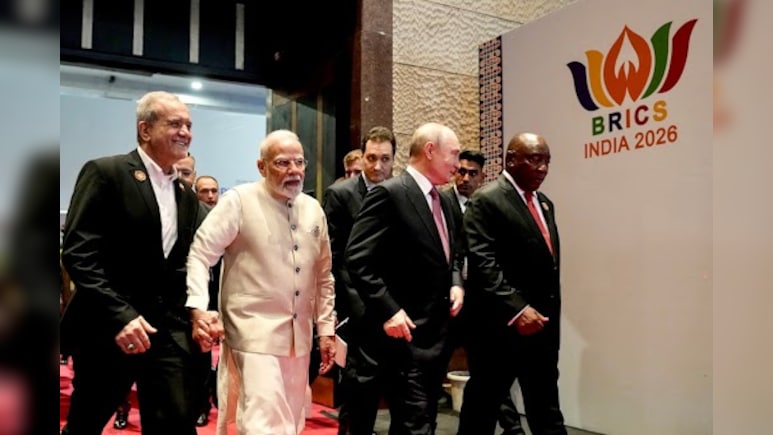
The Iran-UAE confrontation has emerged as the most consequential geopolitical stress test for BRICS since its expansion. What was presented as an effort to give greater institutional weight to the Global South has, in 2026, confronted the harder reality of managing deep strategic divergences among a larger and more heterogeneous membership. The crisis has exposed the limits of a consensus-driven model when two full members find themselves on opposing sides of an active conflict.
An Old Rivalry
Iran and the UAE entered the expanded BRICS framework alongside Egypt, Ethiopia, Saudi Arabia and, subsequently, Indonesia. Their incorporation brought into the grouping not merely additional economic weight but also the accumulated rivalries of the Middle East. The longstanding Iranian-UAE dispute over Gulf islands and their contrasting regional alignments were already embedded within the bloc. The escalation of the US-Israeli military campaign against Iran from late February 2026, however, transformed these differences from manageable diplomatic divergences into a direct institutional challenge.
Iran's subsequent missile and drone strikes against US bases and other targets in the Gulf, including sites in the UAE, brought the confrontation closer to BRICS' own institutional space. Abu Dhabi's decision in August to suspend trade and financial transactions with Tehran and close its embassy in Iran further hardened the divide. The disruption of the Strait of Hormuz, meanwhile, ensured that the conflict could not be compartmentalised as a bilateral Iranian-UAE dispute. It became an energy, shipping and economic-security crisis with consequences for the wider global economy.
When Consensus Becomes Constraint
The clearest manifestation of the problem has been diplomatic. At the BRICS Foreign Ministers' meeting in New Delhi in May, Iranian Foreign Minister Abbas Araghchi accused the UAE of facilitating or assisting US-Israeli operations, while the UAE rejected the allegations and stressed Iranian attacks against its territory and shipping. The inability to reconcile these positions meant that the grouping could not produce a full joint communiqué. Instead, the chair's statement acknowledged differing views while allowing members to maintain their respective national positions.
This was not merely a procedural inconvenience. It demonstrated the central paradox of the enlarged BRICS: the more politically diverse the grouping becomes, the more difficult it is to sustain the unanimity that gives its declarations diplomatic significance. Similar tensions surfaced at the BRICS National Security Advisers' meeting later in the year. The organisation's expansion has therefore increased its representational breadth without necessarily enhancing its capacity for collective political action.
The problem is particularly acute because the disagreement concerns an ongoing war rather than a conventional diplomatic dispute. There is little room for carefully calibrated ambiguity when one member demands condemnation of American and Israeli actions while another seeks recognition of attacks on its territory and commercial shipping.
Delhi's Balancing Act
The BRICS Leaders' Summit in New Delhi on 12-13 September has consequently acquired significance beyond the usual summit agenda. The negotiations over a possible Delhi Declaration on West Asia have become a test of whether the Indian chair can prevent the Iran-UAE confrontation from paralysing the organisation.
The competing priorities are difficult to reconcile. Tehran wants an explicit condemnation of US-Israeli military action and a reaffirmation of Iranian sovereignty. Abu Dhabi places greater emphasis on maritime security, the reopening of the Strait of Hormuz and condemnation of attacks on its territory and commercial shipping. Neither side has obvious incentives to dilute its position merely to accommodate a collective BRICS formulation.
Russia has acknowledged that these differences are complicating the drafting process, while Moscow has also offered to facilitate the normalisation of Iran-UAE relations. India, together with Russia, Brazil and Egypt, has been engaged in bilateral efforts to narrow the gap. Yet mediation within a multilateral grouping is inherently constrained when the disputants themselves are members whose consent is necessary for consensus.
The Indian presidency therefore faces a familiar but increasingly difficult diplomatic task: preserving the appearance of unity without allowing consensus to become an exercise in lowest-common-denominator language.
Three BRICS, Rather Than One?
The emerging divisions point to a broader structural problem. BRICS increasingly resembles an aggregation of overlapping strategic priorities rather than a cohesive geopolitical coalition. One broad constituency is inclined towards Iran's sovereignty and legal framing, with Russia and elements within China broadly sympathetic to this position. Another prioritises regional stability, energy security and the uninterrupted functioning of global commerce, concerns particularly relevant to India and Egypt. A third consists of the states directly caught in the confrontation, most sharply represented by Iran and the UAE, alongside Saudi Arabia's wider regional calculations.
This is not entirely new. China-India tensions and the Egypt-Ethiopia dispute over the Nile have previously demonstrated that BRICS cannot simply suspend the rivalries of its members at the door of the organisation. What is different in 2026 is the intensity of the confrontation. The bloc is attempting to manage a conflict in which two of its members are directly implicated and whose economic consequences extend well beyond the region.
The expansion has therefore produced an unintended consequence. It has strengthened BRICS' claim to represent the Global South numerically and geographically, but it has simultaneously imported more regional rivalries into its decision-making structure. The result is a grouping that may find it easier to agree on institutional reform, development finance and trade in national currencies than on the geopolitical crises that increasingly define the international system.
The Economic Dimension
The Iran-UAE rupture also carries a direct economic cost for BRICS. The suspension of bilateral trade and financial transactions complicates the bloc's broader ambition of deepening intra-BRICS economic integration. The disruption of Hormuz adds another layer of vulnerability, particularly for energy-importing members.
The divergence is striking. Higher oil prices may provide benefits to some energy exporters, including Russia, even as they impose inflationary and strategic costs on major importers. The UAE's position as a financial and commercial hub also sits uneasily alongside Iran's effort to develop alternative payment mechanisms designed to reduce exposure to Western financial restrictions.
In this sense, the crisis exposes another contradiction at the heart of BRICS. The grouping seeks to construct greater autonomy from Western-dominated financial institutions, yet its members remain deeply embedded in different parts of the global economic system and therefore have very different assessments of the risks associated with sanctions, financial fragmentation and energy insecurity.
A Unique Setting
The crisis does not necessarily make the New Delhi summit irrelevant. Indeed, BRICS may offer one of the few diplomatic settings in which Iran and the UAE can remain in the same institutional conversation while other influential actors-India, Russia, China and Egypt-retain relationships with both sides. There is consequently some scope for quiet diplomacy, even if a grand political settlement is unrealistic. The summit could provide space for confidence-building measures, maritime de-escalation and discussions aimed at reducing the immediate economic consequences of the confrontation.
But expectations will have to remain modest. If the political declaration is substantially diluted or abandoned, the summit may shift its centre of gravity towards less contentious areas: trade, development finance, transactions in national currencies and the agenda of the New Development Bank. Such an outcome would preserve BRICS as an economic and institutional project, but it would also reveal the limits of its geopolitical ambitions.
The Iran-UAE confrontation ultimately raises a question larger than the drafting of a summit communiqué: what exactly does BRICS seek to become?
If it is primarily an economic and diplomatic platform, internal disagreement over West Asia can be contained. If, however, it aspires to function as a credible alternative pole in global politics, the inability to articulate a collective position during a major conflict involving its own members becomes a significant liability.
The post-expansion BRICS was always going to be more difficult to manage. Greater diversity brings greater legitimacy, but it also reduces strategic coherence. The Iran-UAE crisis has brought this trade-off into sharp relief.
The New Delhi summit will therefore be watched not simply for the language of its declaration but for what that language says about the organisation itself. A carefully negotiated compromise could demonstrate that an enlarged BRICS can absorb serious internal disagreements without losing relevance. A weak or absent political statement, by contrast, would underline the structural limits of consensus in a grouping whose geopolitical diversity is now both its principal strength and its central vulnerability.
(Harsh V Pant is Vice President for Studies at Observer Research Foundation, New Delhi)
Disclaimer: These are the personal opinions of the author

