





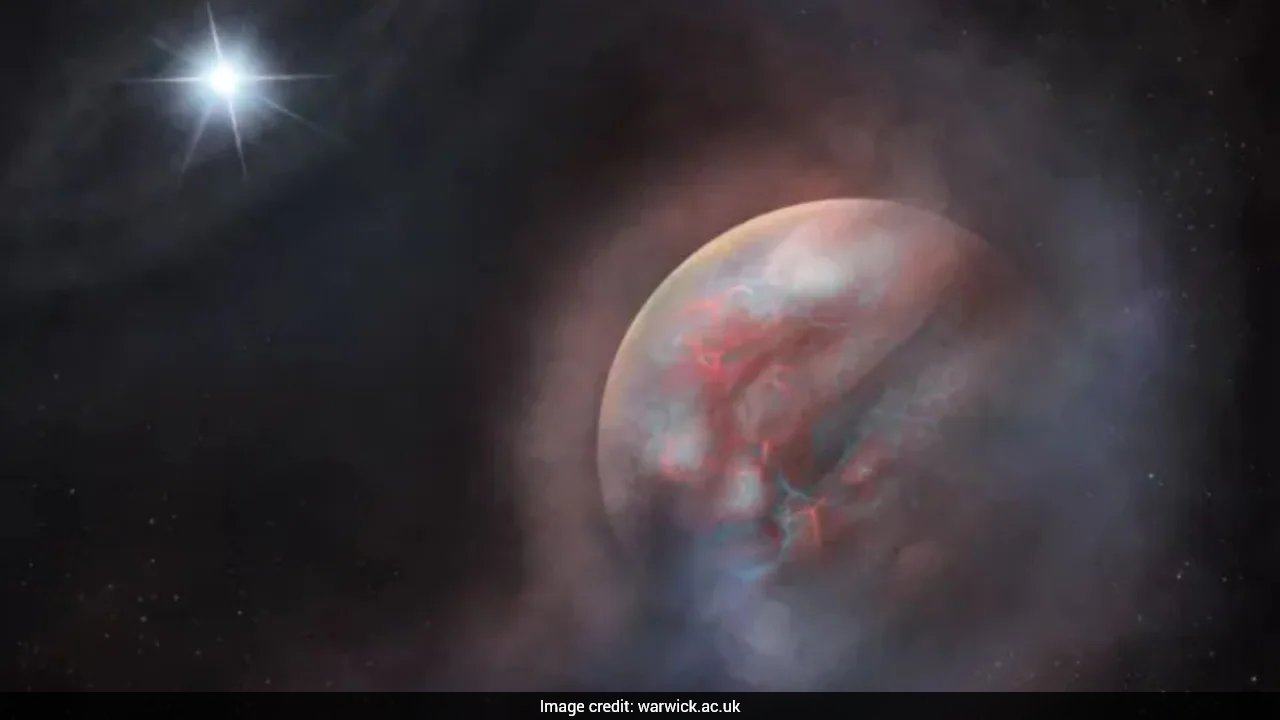
Astronomers have observed a brand-new planet that appears to have formed from the leftover debris of a dying star. Dubbed a "phoenix planet," this newly spotted world offers scientists a fresh look at how planetary systems rebuild themselves after destruction.
The observations were made by a team of astronomers led by the University of Warwick and funded by the European Research Council (ERC). Published in Nature Astronomy, the findings show that even the violent death of a star doesn't always mean that it is the end.
"Second-generation planets are worlds that form out of the material a star casts off as it dies. They're incredibly rare, and finding one around a white dwarf was completely unexpected," first author Jamie Williams, a PhD student in the Department of Physics, University of Warwick, said in the press release.
"It's a bit like finding a planet that has risen from the ashes of the very star it once orbited."
Also read | 80-Year-Old Woman Hosts Her Own 'FOMO Funeral': 'She Refuses To Miss Anything'
How a star's death set the stage
When stars similar to our Sun run out of fuel, they expand into giant red spheres, swallowing nearby planets and blasting out massive clouds of gas and dust. What remains at the centre is a cold, dense star remnant known as a white dwarf.
Normally, the material blown away during a star's death simply scatters into space. In this case, however, gravity helped hold onto a portion of those expelled gas clouds.
The leftover material flattened into a spinning disc around the white dwarf, creating a dusty nursery where brand-new rocks and gas could clump together. Over time, that leftover debris turned into a full second-generation planet.
"This pattern of elements is a telltale sign of the 's-process', a nuclear reaction that builds heavy elements inside dying stars during their bloated red giant phase," Dr Nicholas Stone, Department of Astronomy, University of Wisconsin-Madison, said.
"It's a chemical signature no ordinary, 'first-generation' planet should carry, which told us that this new planet was something different."
Also read | Himalayan Bird Changing Its Voice, Moving To Higher Altitudes Due To Human Activity, Study Finds
Researchers detected the planet by analysing light signatures from the white dwarf system, designated HS 0209+0832.
Using space telescopes like Hubble, astronomers noticed unusual traces of heavy metals, including niobium, being pulled into the dead star's atmosphere.
Scientists realised the star was actively pulling in material from a nearby body because those heavy elements shouldn't normally linger near the surface of a white dwarf. But it confirmed the presence of a close-orbiting planet made from the star's original outer layers.
According to the researchers, if confirmed, HS 0209+0832 would be the first white dwarf found to host a second-generation planet, which opens a new way to search for similarly reborn worlds.
"What's remarkable about the planet around HS 0209+0832 is that this isn't a planet from somewhere else, or a survivor from the system's birth; it looks like it was built from the very material its own star cast off as it died," Professor Boris Gansicke, Department of Physics, University of Warwick, and ERC grantee, said.
"In a sense, this system has given birth to a new world using the foundations of the old one."
Track Latest News Live on NDTV.com and get news updates from India and around the world

