



Planet Mercury
- All
- News
-

From Blood Moon To Planetary Parade: 9 Must-Watch Sky Events Lighting Up March
The month promises planet conjunctions and increased chances of seeing the aurora borealis.
-
Planetary Parade: 6 Planets To Shine Together On Feb 28, Here's How To Watch
This amazing spectacle is created by a special alignment of the planets' orbits.
-
Planetary Parade In February 2026: How And When To Watch Rare Six-Planet Alignment
According to NASA, at least one bright planet can be seen on most nights, depending on the weather.
-
Astronomers Discover "Inside-Out" Planetary System With Rocky World Beyond Gas Planets, Challenging Formation Theories
Since the 1990s, scientists have discovered approximately 6,100 planets outside our solar system, called exoplanets.
-
Planetary Parade In February 2026: When And How To Watch Six Planets Align In A Rare Sky Spectacle
Light pollution won't significantly hinder viewing, but clouds can be problematic, so clear skies are essential.
-
NASA's Astronomers Reveal Red Giant Stars May Destroy Their Own Planets
This extreme expansion poses a serious threat to nearby planets. For example, when the Sun becomes a red giant in about 5 billion years, it will likely swallow Mercury and Venus.
-
Mercury Has Shrunk by Several Kilometers Over Billions of Years, Scientists Report
Mercury’s surface reveals it has been shrinking for billions of years due to cooling and faulting. A new study estimates the planet’s radius has contracted by 2.7–5.6 kilometers, offering the most precise figures yet. The findings sharpen understanding of Mercury’s thermal evolution and could help scientists apply the same techniques to tec...
-
Brightest Planets in June’s Night Sky: How and When to See Mercury, Venus, Mars and Saturn
Skywatchers can spot Mercury, Venus, Mars, and Saturn in prime June skies during dusk and dawn hours. With Mercury at its best visibility, Mars pairing with Regulus, and Venus and Saturn rising before sunrise, celestial highlights abound. A crescent moon joins Mars on June 29, making this month ideal for skywatching and astrophotography.
-
Rare Seven-Planet Alignment 2025: How to Watch in India, Best Viewing Tips
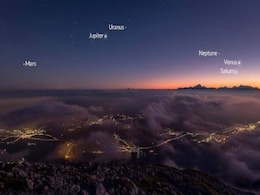
A rare celestial event featuring seven planets—Mercury, Venus, Mars, Jupiter, Saturn, Uranus, and Neptune—aligning along the ecliptic will be visible in 2025. The alignment starts on February 28, with the best viewing in India on March 3. Venus and Jupiter will be easily visible, while Uranus and Neptune will require a telescope. Experts sugges...
-
February 2025 Planet Parade: How to See Five Planets Align in the Sky
A rare celestial event will unfold in February 2025, with five bright planets—Venus, Jupiter, Mars, Mercury, and Saturn—visible in the evening sky. The highlight occurs on February 24, when Mercury and Saturn appear closest. Uranus and Neptune can also be observed with telescopes. Best viewing conditions require a clear west-southwest horizon a...

-
From Blood Moon To Planetary Parade: 9 Must-Watch Sky Events Lighting Up March
The month promises planet conjunctions and increased chances of seeing the aurora borealis.
-
Planetary Parade: 6 Planets To Shine Together On Feb 28, Here's How To Watch
This amazing spectacle is created by a special alignment of the planets' orbits.
-
Planetary Parade In February 2026: How And When To Watch Rare Six-Planet Alignment
According to NASA, at least one bright planet can be seen on most nights, depending on the weather.
-
Astronomers Discover "Inside-Out" Planetary System With Rocky World Beyond Gas Planets, Challenging Formation Theories
Since the 1990s, scientists have discovered approximately 6,100 planets outside our solar system, called exoplanets.
-
Planetary Parade In February 2026: When And How To Watch Six Planets Align In A Rare Sky Spectacle
Light pollution won't significantly hinder viewing, but clouds can be problematic, so clear skies are essential.
-
NASA's Astronomers Reveal Red Giant Stars May Destroy Their Own Planets
This extreme expansion poses a serious threat to nearby planets. For example, when the Sun becomes a red giant in about 5 billion years, it will likely swallow Mercury and Venus.
-
Mercury Has Shrunk by Several Kilometers Over Billions of Years, Scientists Report
Mercury’s surface reveals it has been shrinking for billions of years due to cooling and faulting. A new study estimates the planet’s radius has contracted by 2.7–5.6 kilometers, offering the most precise figures yet. The findings sharpen understanding of Mercury’s thermal evolution and could help scientists apply the same techniques to tec...
-
Brightest Planets in June’s Night Sky: How and When to See Mercury, Venus, Mars and Saturn
Skywatchers can spot Mercury, Venus, Mars, and Saturn in prime June skies during dusk and dawn hours. With Mercury at its best visibility, Mars pairing with Regulus, and Venus and Saturn rising before sunrise, celestial highlights abound. A crescent moon joins Mars on June 29, making this month ideal for skywatching and astrophotography.
-
Rare Seven-Planet Alignment 2025: How to Watch in India, Best Viewing Tips
A rare celestial event featuring seven planets—Mercury, Venus, Mars, Jupiter, Saturn, Uranus, and Neptune—aligning along the ecliptic will be visible in 2025. The alignment starts on February 28, with the best viewing in India on March 3. Venus and Jupiter will be easily visible, while Uranus and Neptune will require a telescope. Experts sugges...
-
February 2025 Planet Parade: How to See Five Planets Align in the Sky
A rare celestial event will unfold in February 2025, with five bright planets—Venus, Jupiter, Mars, Mercury, and Saturn—visible in the evening sky. The highlight occurs on February 24, when Mercury and Saturn appear closest. Uranus and Neptune can also be observed with telescopes. Best viewing conditions require a clear west-southwest horizon a...

