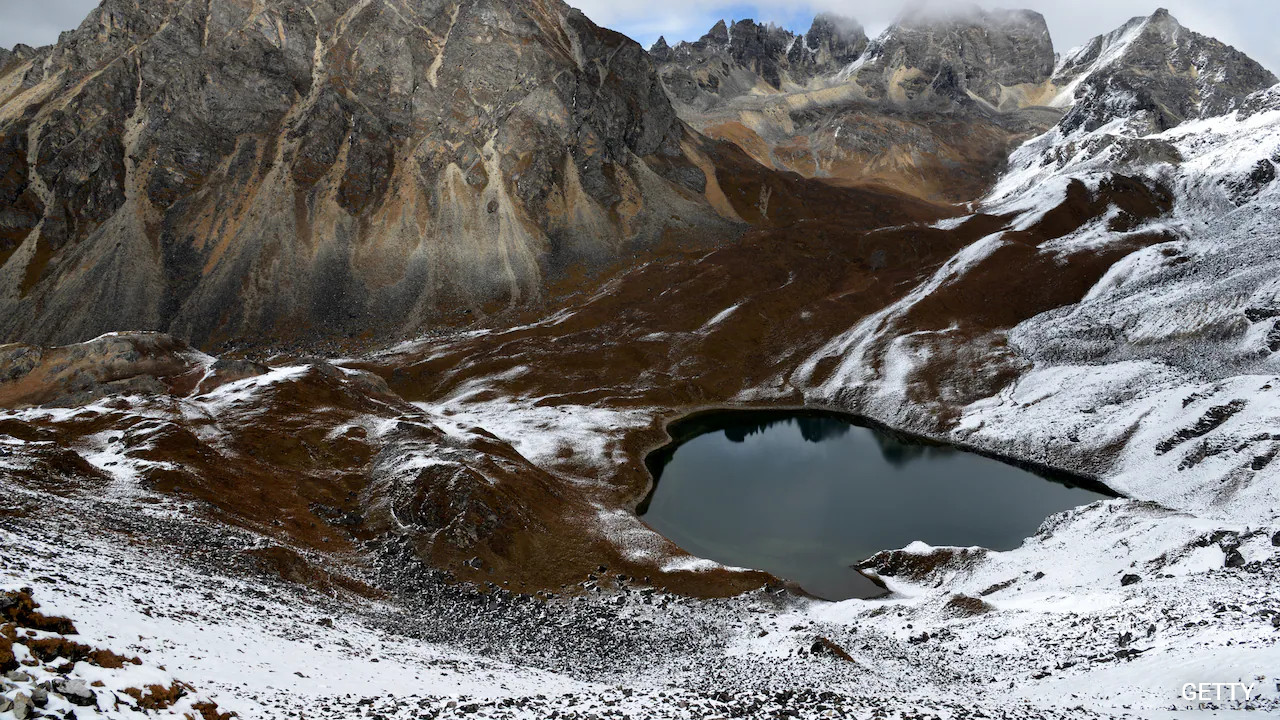
The glacial lake burst in Bhutan, which prompted flash-flood warnings in Assam and parts of West Bengal, has drawn attention to a growing threat in the Himalayas. No casualty has been reported in the incident that occurred on Thursday, but the gush of water washed out entire facilities at Gasa Tshachu, a popular natural hot spring located near the banks of the Mo Chhu River in the Gasa District. Bhutan or Druk Yul in its national language Dzongkha, is located in eastern part of the Himalayans, which are dotted with glacial lakes, some holding enormous volumes of water behind fragile natural barriers. If these barriers collapse, the resulting floods can sweep through valleys, destroy infrastructure and threaten communities far downstream.
Glacial Lake Outburst Floods Explained
Glacial lakes form when retreating glaciers leave behind depressions that gradually fill with meltwater. Many are held back by natural dams made of loose rocks, debris and glacial sediment, known as moraines. These barriers can become unstable due to landslides, avalanches, heavy rainfall or rapid melting. Their sudden collapse can release enormous volumes of water, rocks and debris in a powerful surge. Such events are known as glacial lake outburst floods (GLOFs).
GLOFs have been given a particular nomenclature by the United Nations Development Programme (UNDP). The agency calls them "tsunami in the sky", highlighting their destructive potential.
GLOF And Bhutan's Connection
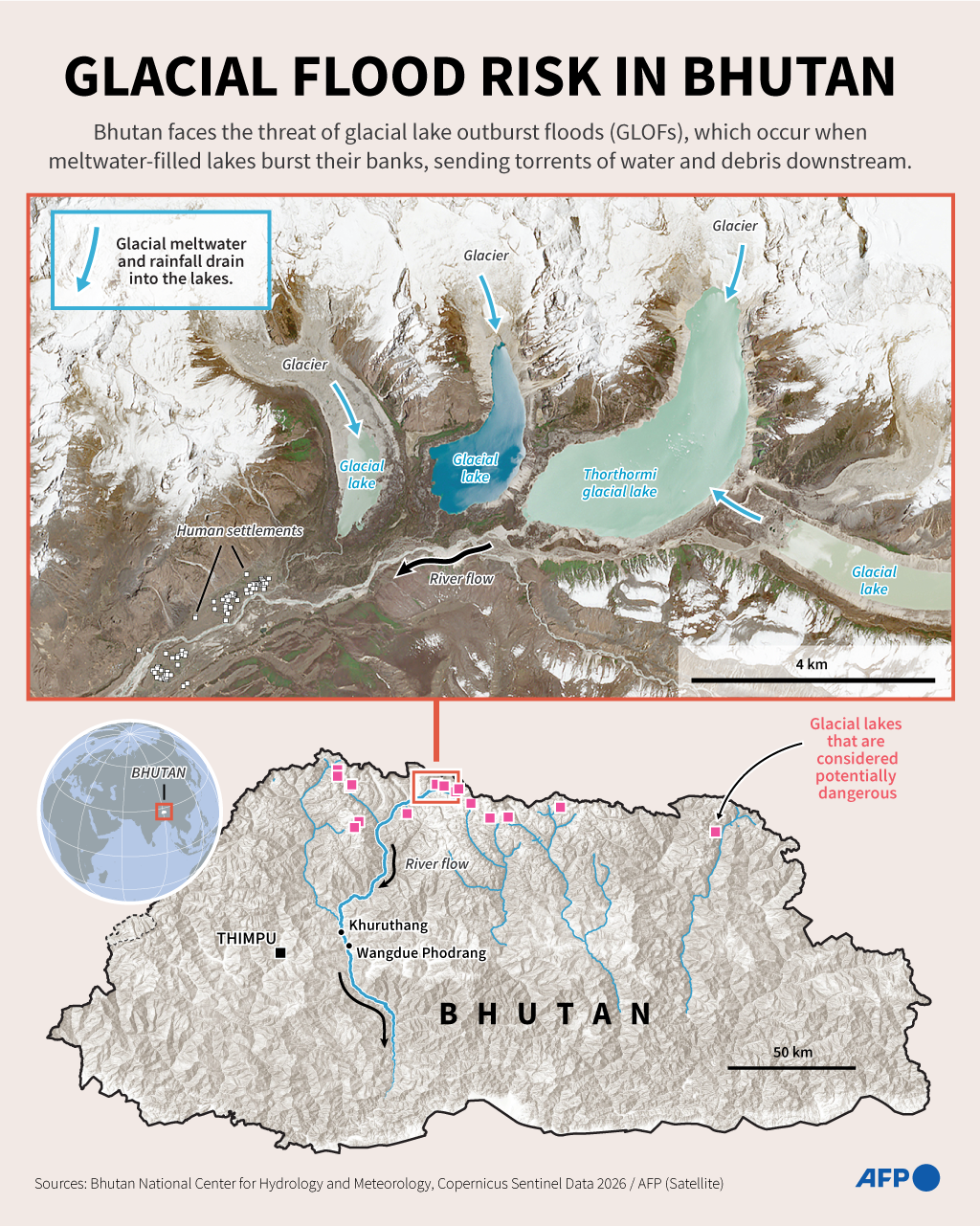
Bhutan's mountainous terrain, glaciers and steep river valleys make it particularly susceptible to such outbursts. According to the country's National Centre for Hydrology and Meteorology, Bhutan has 567 glacial lakes, of which 17 have been classified as potentially dangerous.
An earlier assessment had identified 25 potentially dangerous lakes. Subsequent investigations revised the number to 17 after eight lakes were found to pose relatively lower risks.
However, these studies do not mean that Bhutan is on the verge of a catastrophe. Their risk depends on factors such as the stability of natural barriers, water volume and the population and infrastructure downstream.
The Thorthormi-Raphstreng Threat
Among Bhutan's most closely monitored glacial lakes are Thorthormi and Raphstreng in the Lunana region. The two lakes are separated by a moraine barrier, whose stability has raised concerns among scientists. A 2023 study published in the Journal of Hydrology assessed four potentially dangerous lakes in the region: Bechung Tsho, Raphstreng Tsho, Thorthormi Tsho and Lugge Tsho.
Researchers modelled potential outburst scenarios, estimating flood volumes ranging from 600,000 cubic metres to 300 million cubic metres. The scenarios suggested that more than 16,000 people and infrastructure up to 150 km downstream could be exposed.
These are modelled risks, not predictions that the lakes will necessarily burst.
The 1994 GLOF Disaster
On October 6, 1994, a partial collapse of the moraine dam at Lugge Tsho triggered a devastating flood that killed around 21 people and damaged homes, farmland and infrastructure. A 2024 study published in Natural Hazards and Earth System Sciences mentioned other GLOF events in Bhutan, including those involving Tshojo Lake in 2009 and Lemthang Tsho in 2015.
Researchers have documented at least 18 GLOF events in Bhutan since the 1950s, although historical records remain incomplete.
How Climate Change Is Adding To The Danger
Rising temperatures are accelerating glacier retreat across the Himalayas, creating new glacial lakes and causing existing ones to expand. Warmer conditions can also weaken mountain slopes and permafrost, increasing the risk of landslides and avalanches entering glacial lakes.
However, climate change does not automatically trigger a GLOF. The risk depends on the physical condition of individual lakes, their natural barriers and surrounding terrain.
For Bhutan, the challenge is particularly serious because settlements, roads, agricultural land and hydropower infrastructure are often located along river valleys.
Bhutan has been strengthening its monitoring and early warning systems through satellite observations, field assessments and river-level monitoring. But predicting an outburst and ensuring that downstream communities receive adequate warning remain major challenges.
Track Latest News Live on NDTV.com and get news updates from India and around the world


