Chinese automakers' ambitions to shave even more time off their breakneck development speeds are facing a reality check as regulators ramp up scrutiny of the industry's safety and testing.
As competition grows and margins get squeezed, the use of artificial intelligence could set a new industry standard of just 18 months for bringing a brand new model to market, according to an estimate from car designer IAT Automobile Technology and China's Association of Automobile Manufacturers. That's down from the current pace of around two years and compares with roughly three to five years for legacy foreign competitors.
But while China speed has set the new global benchmark and sent legacy brands into an existential fight for market share, it's also fueled concerns that automakers' rapid innovation could outpace both regulatory oversight and their own quality-control capacity. Within the industry, debate is growing around whether compressed timelines risk damaging the reputation of Chinese brands - particularly as they push into overseas markets like Europe - or simply showcase their competitive edge.
Chinese regulators are pushing hard on safety, launching a yearlong campaign that includes surprise inspections at carmakers to address concerns that quality could deteriorate in the pursuit of speed. Their view is in line with recent comments from executives at Zhejiang Geely Holding Group, Great Wall Motor Co. and Chery Automobile Co., who have warned that the faster development times essentially turn customers into guinea pigs who test durability or safety in real time.
"Cars aren't fast-moving consumer goods. They touch the safety of millions of families and must endure the test of diverse road conditions, climates, and driving habits worldwide," Li Xueyong, vice-president at Chery, said in an Aug. 26 social media post. "There are simply some development timelines we cannot afford to shortcut."
The tougher stance is part of a broader overhaul that's already seen tighter regulations imposed on batteries, advanced driver-assistance technology and door handles in the wake of several high-profile, fatal accidents. The country is carrying out its largest vehicle recall ever, with Tesla Inc. and eight other carmakers set to fix more than 4.27 million electric vehicles to meet new door requirements.
China is also proposing to double mandatory road testing for new-energy vehicles to 30,000 kilometers (18,640 miles) - a move to address concerns that shortened processes may erode safety standards and public trust.
Chinese carmakers have been pushing the limits of the time it takes to develop vehicles that comply with safety rules, according to two people familiar with testing and validation processes in China, who asked not to be identified because they're not authorized to speak publicly.
The Ministry of Industry and Information Technology is paying close attention to customer complaints online, according to two executives at a Chinese automaker, who asked not to be identified because they're not authorized to speak publicly. After some of the manufacturer's models garnered complaints over a defect, the regulator contacted the company to query what it was doing to fix it before it had managed to arrange replacement parts and coordinate with dealers and repair shops, the people said. An official recall went out about a month after the issue started.
In a break with tradition, the ministry is now announcing which carmakers it's inspected swiftly after a visit. At least five leading automakers were inspected in July, with a visit to Guangzhou Automobile Group Co.'s Aion coming just days after reports that batteries in some models were failing after the car notched 150,000 kilometers. The brand has said it's repairing or replacing the batteries for free.
Hard to Slow
The safety push is likely to come into conflict with the frenetic pace of the industry that saw China's auto market flooded with hundreds of model launches and refreshes in the first half and includes rapid incorporation of AI into every part of the auto supply chain.
"Speed has become embedded in the Chinese industry's operating model, and consumers expect rapid product renewal," said Bill Russo, founder of Shanghai-based consultancy Automobility Ltd.
The inspection campaign "could force companies to be more disciplined about where they compress time. They can continue moving quickly in software, digital features and areas that can be thoroughly validated through simulation, but regulators are clearly signaling that safety-critical hardware and new technologies need stronger validation before being put into customers' hands," he said.
| Date Released | Effective Date | Regulation |
| February 2025 | February 2025 | Strengthen intelligent connected vehicles product approval, recall and software OTA updates, raising the bar for carmakers in releasing OTAs as a fix for issues they should have resolved before selling |
| March 2025 | July 2026 | New EV battery standards including stipulations that batteries shouldn't burn, explode or release smoke in a thermal runaway event for at least two hours |
| December 2025 | July 2026 | Standards for steer-by-wire EVs which uses sensors, control units and electric actuators to replace traditional mechanical steering involving hydraulic components |
| December 2025 | July 2026 | EV safety requirements such as instantly turning off the high voltage system in the car with a physical device such as a button, if needed |
| January 2026 | January 2027 | New safety standards for door handles that ban concealed designs popularized by Tesla |
| July 2026 | July 2027 | Rules to specify when and where advanced driver assist technology can be used, requirements for drivers to pay attention to the road, guidance on training drivers, data collection etc. |
| July 2026 | July 2027 | Safety requirements for high level of autonomous driving where vehicles can drive with minimal human intervention |
Even with scrutiny from regulators and customers intensifying, a speedy development pipeline on its own isn't necessarily a problem, according to some in the industry. If a car is developed quickly and has completed all required testing then it's just a demonstration of efficiency, Lu Fang, chairman of Dongfeng Motor Corp.'s luxury Voyah brand, has argued.
And China's automakers are going to struggle to slow down, with shrinking sales and rising raw material costs compressing already thin margins across the supply chain. At the same time, consumers are demanding frequent new model launches and constant upgrades.
"I think it's not really possible to ask anyone to slow down. Everyone's in a race to get in front," Zhejiang Geely Holding Group Chairman Li Shufu said during an interview with state broadcaster CCTV that aired on June 20. "This ask might be too hard. If you ask me to slow down, I might not say yes."
Meeting the stricter standards also risks splitting the industry further given the higher cost of compliance. Smaller companies that have relied heavily on speed and aggressive rollouts of features may find it harder to keep pace with larger, better-capitalized manufacturers with mature management systems, according to Automobility's Russo.
Still, Chinese carmakers will be able to maintain a lead over foreign rivals because of their greater embrace of new technologies like AI, according to Xuan Qiwu, chief executive officer of IAT.
That's despite growing efforts from legacy automakers to catch up to their Chinese rivals.
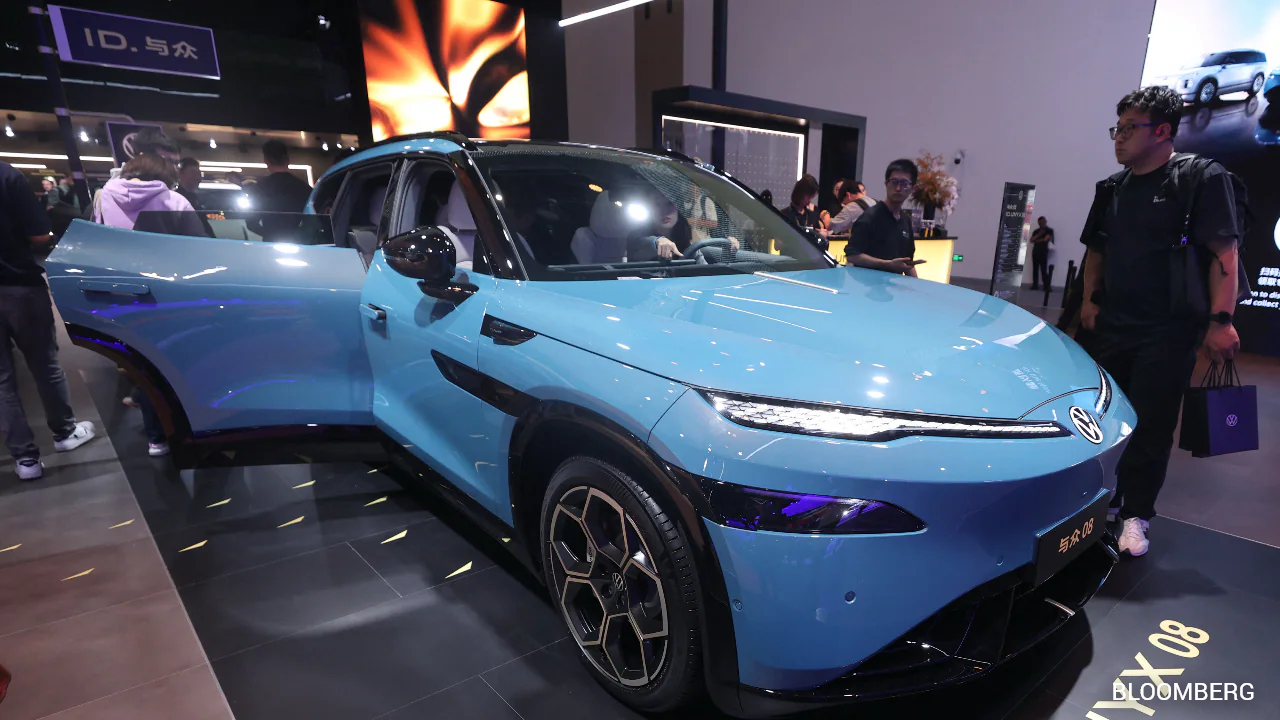
Volkswagen AG's wholly owned research and development base in China's Anhui province is the first outside of Germany that's capable of designing and testing vehicles entirely on its own. Its ID.UNYX 08, an electric SUV produced in partnership with Xpeng Inc., was developed in 24 months and used AI and virtual reality technology to complete digital validation. Separately, Renault SA developed the Twingo E-Tech in China in 21 months, a record for the company.
Meanwhile, Toyota Motor Corp. is trying to speed up a cycle that usually takes three to five years for model changes. That includes developing a new automotive platform and vehicles in tandem rather than consecutively, according to a documentary released by Japanese broadcaster NHK in July.
AI means time savings can be won across dozens of processes including reviewing digital design mockups to assess a vehicle's structure and functionality before moving to constructing a model - a task that when performed by engineers, requires manually checking tens of thousands of components.
And with Beijing now setting a safety baseline, carmakers will need to compete within those boundaries.
"While AI can help carmakers to be as fast and as accurate as possible, and reduce the amount of design errors, there are baselines such as the 30,000-kilometer or 50,000-kilometer on-road testing that can't be replaced and shouldn't be replaced," said Yale Zhang, the managing director of Shanghai-based consultancy Automotive Foresight.
(Except for the headline, this story has not been edited by NDTV staff and is published from a syndicated feed.)
Track Latest News Live on NDTV.com and get news updates from India and around the world


