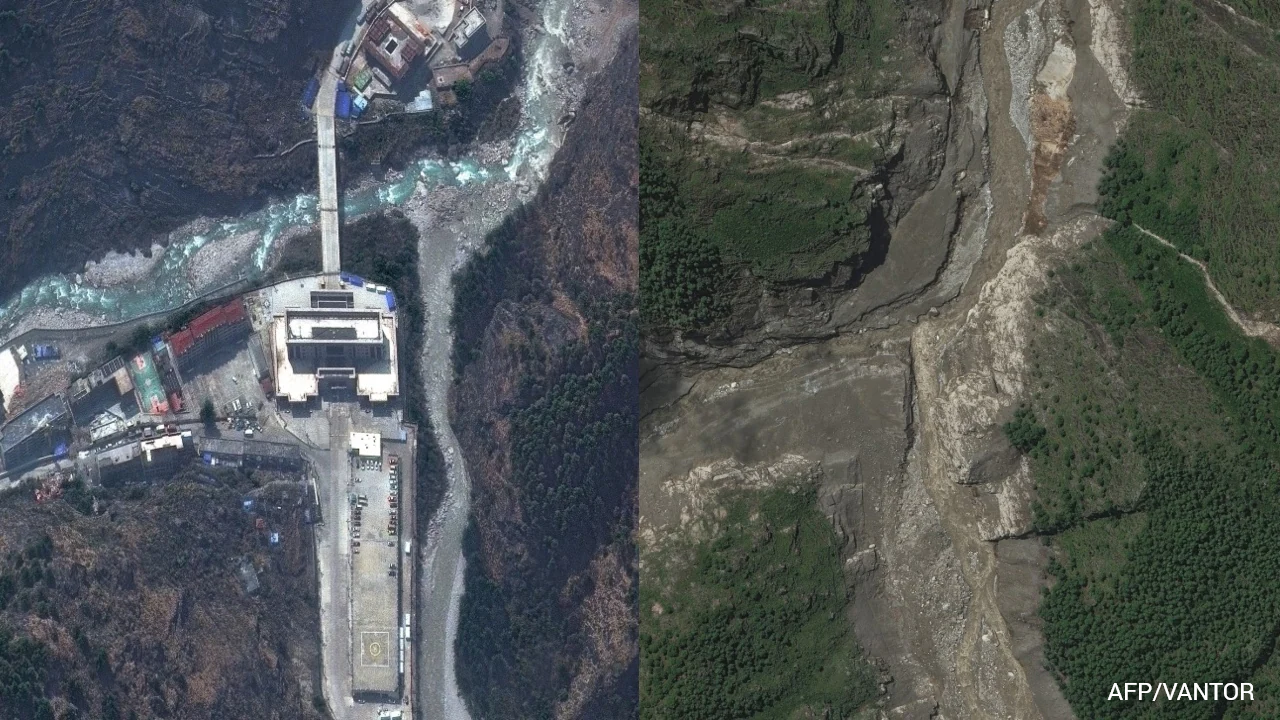
Over 469 people have been killed and nearly 1,500 are missing after a massive flash flood hit Nepal this week, as authorities in China flagged more geological risk upstream. Indians make up the largest number of missing foreigners, with Nepal's new tourism board's data showing 178 people from the country were missing. Eleven others had been rescued.
Many of the missing are foreign tourists, including trekkers in the Himalayan nation and scores of Hindu pilgrims to Tibet's sacred snow-capped Mount Kailash.
New satellite imagery from Vantor technology showed that the Tibet-Nepal Rasuwagadhi border crossing has been completely destroyed, with the glacial flood completely scouring the valley floor.
Aerial footage also showed a lake had formed and expanded on the Tibet-Nepal border, with authorities warning of a possible dam break.
A barrier lake near the Nepal-China border is overflowing and could breach, Chinese authorities warn. It formed a day after flash floods killed hundreds in nearby communities. The lake held about 2 million cubic metres Thursday, with another 3 million expected within three days. pic.twitter.com/9I15tN3Tgb
— Open Source Intel (@Osint613) August 27, 2026
China Sounds New Disaster Alarm
Beijing has sounded a 'Level-IV' alert at the Tibet-Nepal border, warning that a barrier lake formed by Wednesday's mudslide, at the confluence of two rivers, faces a high risk of breaching and flooding downstream areas.
China's Ministry of Water Resources sounded an emergency in the Tibet Autonomous Region, cautioning of a threat posed by the barrier lake, which formed near the confluence of the Chhochen Khola and Purepu Tsangpo rivers. These rivers originate in Tibet and flow into Nepal as part of the Bhote Koshi river system.
Beijing said the lake has accumulated an estimated two million cubic meters of water as of Thursday morning, and amid continued rainfall in the region, inflows into the lake could reach about three million cubic meters, risking a breach, state-run Xinhua News Agency reported.
A breach that could send floodwaters downstream and potentially cause further damage in areas including Gyirong Port at the China-Nepal border and elsewhere downstream. China's emergency response system for natural disasters has four levels, with Level I being the highest and Level IV the lowest.
Floods in Nepal
Rescue teams and military helicopters are searching for hundreds of missing people along the mountainous Nepal-China border, where a deadly torrent of water and mud several stories high swept through communities this week following a glacier collapse.
Videos of the disaster showed people running before the floodwaters swallowed them up and washed out buildings and bridges. More than 469 people were killed, according to authorities in Nepal and China, and 1,468 were missing, while hundreds of others were displaced across the Himalayan region.
The lush valleys of the Himalayan mountain range -- home to many of the world's highest peaks and remaining glaciers -- are especially vulnerable to flooding and landslides. Melting glaciers have become more common because of human-caused climate change.
Nepal Turns Down Rescue Help
The Nepal government has reportedly turned down offers from several countries to send search and rescue teams to search for thousands of people still missing in the flood-hit areas. According to The Strait Times, the Prime Minister Balend Shah government has said Nepali security agencies can handle the search and rescue operation.
Instead, officials reportedly said Nepal wants cash contributions through a one-door mechanism, and additional financial aid and other support will be sought during the reconstruction phase.
Several countries have already announced financial assistance, while others have expressed their willingness to support search, rescue, rehabilitation, and reconstruction efforts as well.
Track Latest News Live on NDTV.com and get news updates from India and around the world


