Russia's 'Human Safaris' Are Bringing Terror To Ukraine's Frontline Cities
Kherson is among the first places where Russian forces began using short-range FPV drones against civilians. Equipped with live-streaming cameras, the aircraft allow operators to observe targets in real time and make decisions moments before impact.
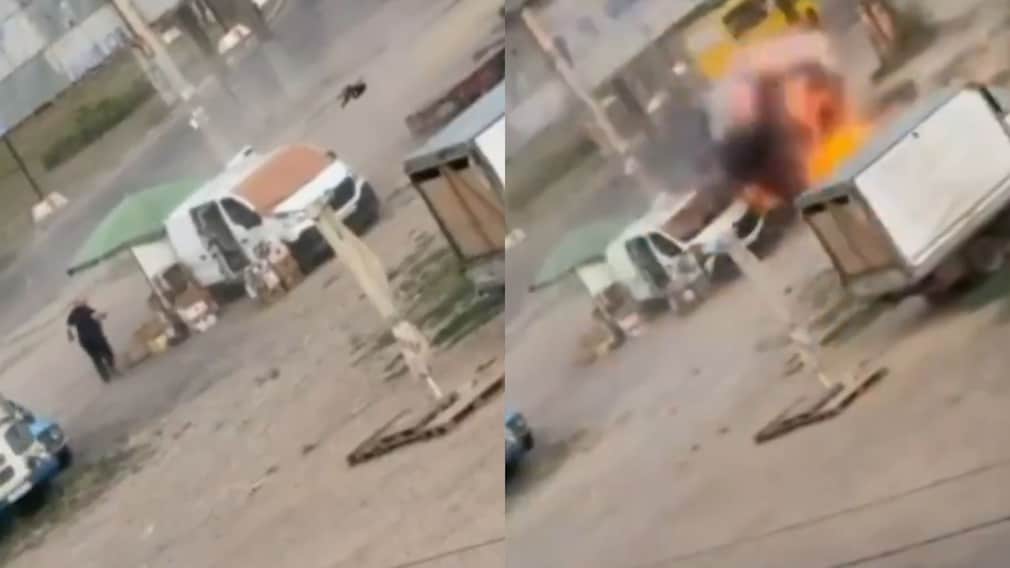
Yuri had barely begun arranging his vegetables and fruits in the morning at the market in Ukraine's Kherson. The 52-year-old vendor was cleaning garlic when he heard the buzzing. Within seconds, a Russian first-person view (FPV) drone emerged from behind the market.
It did not immediately explode though. Instead it followed him around like a predator.
As Yuri darted between umbrellas, circled his vegetable cart set up on his pickup truck and desperately waved his arms, the drone appeared to mirror his every move. It pursued him around the truck before detonating beside him, spraying shrapnel across his body.
Video of the incident, shared by Ukrainian President Volodymyr Zelensky, quickly went viral online.
"I begged him, it's only garlic, that's all," Yuri later recalled from the hospital, speaking to journalist Zarina Zabrisky.
"We came to the market and started to set up. I don't know where the drone came from. It flew out from behind the market. There were banana boxes and I am running around. It's all under an umbrella. I had no phone. I had two garlic cloves as I was cleaning garlic," Yuri said.
🔴 EXCLUSIVE: An interview with the human safari survivor.
— Zarina Zabrisky 🇺🇸🇺🇦 (@ZarinaZabrisky) August 4, 2026
Yuri, 52, was sorting out garlic at his farmers market stand when a Russian drone started to chase him. It pursued Yuri around in circles and then struck him.
Yuri and his doctor spoke to me at a hospital in Kherson🧵 pic.twitter.com/f2CCZiM34M
"I told my wife to run and I stayed there because there was just a field and we were 200 metres away from a shelter. Maybe some athletes can run but I can't," he added. "I started running back and forth under the umbrella. I waved my hands and I wanted to save the car. I wanted to show it that we have nothing else left to work with. We had one car left. We had another destroyed. Another drone had already hit this car and we had to fix it."
"Maybe its battery was dying and it just started chasing me to kill at least someone. Because I am not a military target. I have never served in the army. Not during Soviet times or now because I was always sick and they always wrote me off," he added.
The Safari Drones
The attack has drawn attention not only because of the video itself, but because of the language increasingly being used to describe such strikes. The Ukrainian drone battalion Signum, which has extensive experience operating fibre-optic FPV drones, says the term "safari drones" has emerged because Russian operators appear to be deliberately hunting civilians.
"Because they kill unarmed civilians. Because on safari you hunt with a gun on unarmed animals," members of Signum unit told NDTV.
READ | NDTV Exclusive: The Hunters Of Lyman - Inside Ukraine's Deadliest Drone Unit
The comparison reflects what many Ukrainians believe distinguishes these attacks from conventional military operations. Rather than striking military positions or infrastructure, the drones appear to follow civilians on foot before detonating. The video of Yuri's attack became one of the most widely circulated examples.
One question immediately raised by the footage was how a drone could penetrate so deeply into what appeared to be a functioning city. A close watch of the video shows the market was open, a school bus could be seen driving nearby, vendors were unloading vegetables. To outside observers, it appeared to be an area where civilians still attempted to maintain ordinary life.
"Seems they (Russians) have used 20-25 km fibre-optic reel," Signum unit told NDTV.
Unlike conventional FPV drones controlled by radio signals, fibre-optic drones remain physically connected to their operators by an ultra-thin cable. As the drone flies, the cable continuously unspools behind it from a reel carried onboard. That connection makes the system fundamentally different from traditional drones.
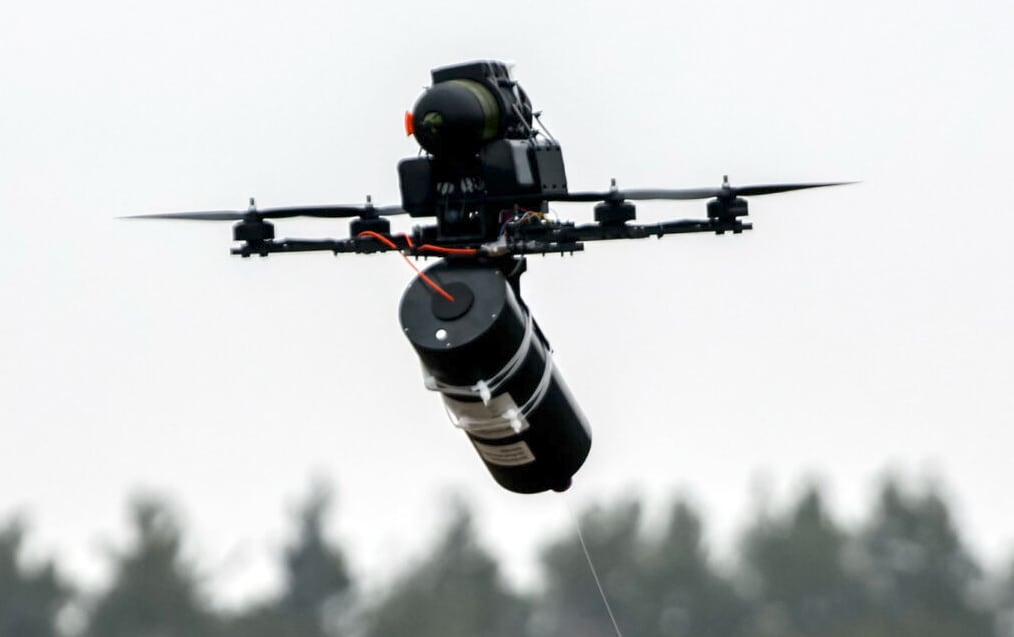
An Ukrainian FPV drone with fibre-optic cable.
Photo Credit: Ukrainian Army
Instead of transmitting commands and live video over radio frequencies, every movement of the pilot's controls and every video frame travels through an extremely thin glass fibre physically linking the drone to its operator. The pilot wears first-person-view goggles and flies using a handheld controller. As the aircraft advances, the fibre-optic cable unwinds behind it much like fishing line leaving a reel.
READ | NDTV Exclusive: Rifle, Tactical Gear And A Long Wait - Inside The Kill Of A Ukrainian Sniper
Operational reels commonly carry between five and twenty kilometres of cable, although Signum battalion believes the drone that pursued Yuri may have carried between 20 and 25 kilometres.
Most fibre-optic drones are attack drones carrying relatively small explosive charges. Rather than dropping bombs, they are flown directly into their targets.
Because there is no radio control signal, electronic jamming cannot sever the connection between pilot and drone. Unless the cable itself breaks, operators continue receiving uninterrupted, high-quality video while retaining precise control.
The technology is not without drawbacks though.
The cable increases the drone's weight, reducing both endurance and payload. Additionally, The fibre can snag on trees, fences, power lines or rubble. Its maximum range depends entirely on the length of the spool.
How Drones Reach Cities
Kherson, the regional capital, once home to around 280,000 people, fell under Russian occupation in March 2022 before Ukrainian forces retook it in November that year.
Russian troops remain positioned across the Dnipro River. From there, they continue striking the city using artillery, missiles and increasingly FPV drones.
"Drones are used precisely because they can quickly fly past infantry or fly along routes where there is no infantry, such as along a river or very high up,' Signum battalion told NDTV.
Kherson was among the first places where Russian forces began using short-range FPV drones against civilians. Equipped with live-streaming cameras, the aircraft allow operators to observe targets in real time and make decisions moments before impact.
READ | Game Of Drones: Ukraine's Sting Answer For US' Shahed Problem
The practice later spread more than 300 kilometre along the right bank of the Dnipro River into parts of Kherson, Mykolaiv and Dnipropetrovsk regions.
Detecting fibre-optic drones is particularly difficult.
"A drone on fibre-optics is not detected by electronic intelligence," Signum battalion told NDTV. "It can be detected by sound or visually. And once detected, can be taken down with guns."
Unlike radio-controlled drones, electronic warfare equipment provides little assistance because there is no radio transmission to locate or disrupt.
"Ukraine has innovated rapidly and is now capable of producing drones with a range of over 3,000 km. Fire Point's FP-series drones are the latest mass-produced drones that can strike inside Russia, compensating for the absence of long-range missiles in Ukraine's arsenal. The FP-5 Flamingo drone has a range of 3,000 km and can carry a 1.15-ton payload at a cruising speed of 800 km/hr. It was used in June to target a Russian factory that produces key components of drones," Divyam Sharma, defence expert, told NDTV.
"Drones make peace more difficult to achieve or work towards by reducing the costs and risks of continued fighting, allowing both states and non-state actors to sustain conflicts without committing to large-scale military offensives. Their affordability, persistent surveillance, and strike capabilities encourage constant low-level violence, even during ceasefires, while making retaliation easier and less politically costly. This blurs the line between war and peace, undermines trust between adversaries, and weakens incentives for negotiation. Consequently, drones can extend conflicts by sustaining a continuous state of low-intensity warfare rather than fostering the conditions required for a lasting political resolution," he added.
'The World Must See This'
Ukraine's President Zelensky called upon the international community to pay attention to the Russian attacks on frontline cities.
"Today, many were shocked by yet another video of the drone 'safari' Russians are carrying out against civilians in Kherson. A Russian drone deliberately hunted down a man selling vegetables and detonated right next to him. The Russians even admitted to the crime, showing zero regret and openly boasting about tormenting people. The man was wounded in the blast. Every single day, ordinary people in Kherson face these Russian 'safaris'," Zelensky wrote on social media.
Today, many were shocked by yet another video of the drone “safari” Russians are carrying out against civilians in Kherson. A Russian drone deliberately hunted down a man selling vegetables and detonated right next to him. The Russians even admitted to the crime, showing zero… pic.twitter.com/uGjC7esFwR
— Volodymyr Zelenskyy / Володимир Зеленський (@ZelenskyyUa) August 4, 2026
"The world must see this. It must see every piece of evidence that Russia has gone mad and that its soldiers take pleasure in killing and abusing civilians," he added.
International Condemnation
The United Nations Independent International Commission of Inquiry on Ukraine says the pattern of attacks leaves little doubt about their intent. In an October report, investigators concluded that repeated drone strikes had killed and wounded civilians, destroyed homes and forced thousands to flee.
The commission concluded that the attacks amounted to the crimes against humanity of murder and forcible transfer. Investigators said Russian units positioned on the occupied left bank of the Dnipro were responsible.
The commission identified specific drone units, operators and commanders involved. It also documented Russian Telegram channels routinely sharing videos of attacks, often accompanied by mocking captions and threats of further strikes.
The report said the attacks had spread terror among civilians while violating their right to life and other fundamental human rights.
The commission also examined Russian allegations that Ukrainian forces had carried out drone attacks against civilians in occupied territories.
It said investigators were unable to reach conclusions because they lacked access to those territories, could not adequately protect witnesses and received no responses from Russian authorities.
According to the UN Human Rights Office, short-range drone attacks have become the leading cause of civilian casualties close to the front line. Local authorities say that since July 2024, more than 200 civilians have been killed and more than 2,000 wounded across three southern regions.
-
Opinion | Bankipur, And Why The Most Dangerous Voter Is The One Who Thinks Again

Bankipur is like the NOIDA of Uttar Pradesh. Its voter list isn't like the rest of Bihar. Which is why one must be careful in declaring Kishor's win a phenomenon - yet. But then, there's the power of the voter...
-
Opinion | Prashant Kishor May Just Be Playing Two Games At Once In Bihar
The Jan Suraaj is neither a 'BJP-lite' option for disaffected upper-caste voters, nor is it an RJD alternative for Muslims. It is, in fact, both things at once, in the same seat, in the same election.
-
Opinion | Inside The Cabinet Drama That Has Shaken The Congress In Karnataka
Siddaramaiah's decision to 'boycott' the swearing-in ceremony because of a perceived 'insult' is a story in itself.
-
Opinion | The Panic In Rawalpindi: Why Pakistani Generals Suddenly Sound So Afraid
Lectures on governance and usual accusations against India aside, the truth is that Pakistani generals are fast losing their grip on the country.
-
Opinion | Bankipur Is Prashant Kishor's Stinging Comeback. But It Is Also The End Of His 'Excuse'
Kishor's ideological flexibility helped make him a successful strategist, but it remains a political vulnerability.
-
As AI Takes Jobs, Could It Also Create A New Generation Of Entrepreneurs?
The job market has already begun feeling the impact of AI as companies automate more tasks and rethink hiring. However, India Inc and global industry captains believe the AI disruption could mean spawning a new wave of entrepreneurs.
-
Ahmedabad 2030 Isn't Just About Commonwealth Games, It's India's Olympic Audition
Ahmedabad will host the 2030 Commonwealth Games, exactly a century after the event first began in Hamilton, Canada. India hosted once before, in Delhi in 2010
-
Opinion | Kangana Ranaut Is Fast Running Out Of Enemies To Pick On
Kangana spent years cultivating the image of the 'lupa', the lone she-wolf who survived without a pack. But rebellion, once rewarded, can quickly become an addiction.
-
Opinion | 17 Dead, 166 Trapped: How Indian Seafarers Became 'Collateral' In Others' Wars
India is now the second-largest supplier of seafarers in the world, contributing 311,936 personnel. But that also means that they are among the easiest targets during war.
-
Demography Awaits Dividend: BRIC By Brick, India Built Growth But Not Jobs
Twenty-five years, five governments and several hundred investment summits later, demography is waiting for politics to propel the promise.