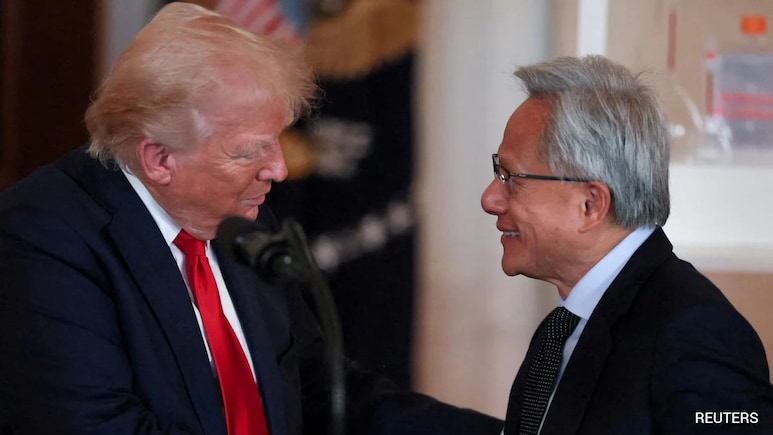
Jensen Huang is back at the helm of Nvidia after an 11-day period of disorder that included his resignation and reinstatement following the admission of his scandalous affair with Alice Huang, an executive at Singapore-based company Megaspeed, who US intelligence suspects of being a Chinese spy.
The 10-person board unanimously voted to rehire Huang as Nvidia's president, CEO and a fellow board member, writing in an announcement that the decision followed discussions with Huang and assurances "from senior levels of the United States government" that the 63-year-old co-founder's involvement posed no security threat.
US President Donald Trump himself has taken credit for pushing for Huang's reinstatement, saying he was vital for the United States' AI dominance. But during his latest interview with CNBC, Trump's own explanation about his intervention appeared to conflict with US intelligence's China espionage concerns and his own administration's action on the matter.
What Trump Said
Talking about his involvement in Huang's return to Nvidia, Trump told CNBC that the chipmaking company's board "did ask for assurance on the national security threat."
"We gave them assurance, at least with everything we know, and we know a lot. So with everything we know, we gave them assurance," he said.
But despite his repeated reassurance that Huang poses no security threat to the United States, Trump also implied he could take Nvidia's most advanced AI chipmaking knowledge to China if the US angered him.
"You know, Jensen could be angry at our country. He'd say, I'm going to go to China. Well, he's got the Blackwell in his brain. It's his baby. That's the thing," Trump said, even though Huang himself has never talked about moving to China.
Highlighting the risks of losing Huang's expertise to China, Trump said, "I know what President Xi is thinking because I would be thinking like, why don't we make a deal with Jensen? We don't have to bother with all the stuff. We don't need spies. Let's hire Jensen."
The Contradictions
Trump also implied that the Justice Department has cleared the Nvidia executive of personal wrongdoing. "They did a pretty good investigation, and they felt that he himself was exonerated," he told CNBC.
However, despite Trump's tall claims, the embattled chief will nevertheless have to explain himself to lawmakers at a closed-door hearing on December 1 before three House committees.
He will also testify before a Senate committee on December 3 in a hearing that will be livestreamed, while California's attorney general has opened an investigation into the company's chip exports and shareholder disclosures.
In parallel, the Securities and Exchange Commission (SEC) has also reportedly launched an investigation into Nvidia's accounting practices and potentially misleading communication to shareholders.
The California Department of Justice has also announced that it is asking Nvidia whether its advanced chips or confidential information may have gone to China and whether Nvidia misled investors and the public.
Nvidia itself is continuing its own internal investigation, even after Huang has been reinstated.
Though the ongoing probe into Huang and Nvidia's workings does not necessarily contradict Trump's claim, the scrutiny is far from closed.
Trump also dismissed the concerns regarding Alice Huang's link with the Chinese spy agency and said, "As far as the woman is concerned, every time you have a Chinese woman that's good-looking or beautiful, they say she's a spy."
The US Department of Justice is still investigating Alice Huang's link to Beijing and Megaspeed, a company based in Singapore that allegedly bought processors from Nvidia and routed them to Chinese customers, circumventing US export restrictions.
Track Latest News Live on NDTV.com and get news updates from India and around the world


